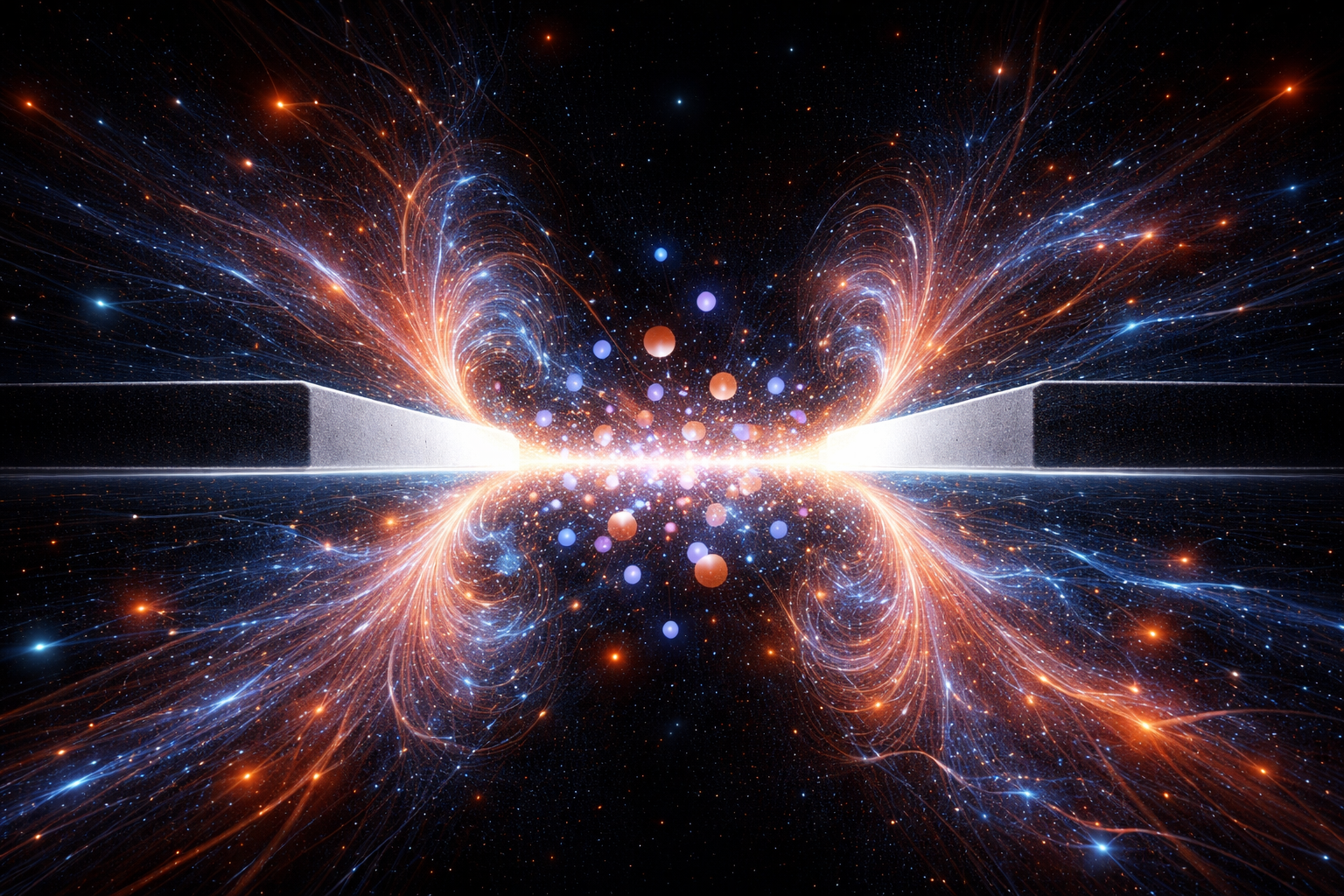
What if empty space isn’t empty… but one of the most active things in the universe?
For most of scientific history, the vacuum was treated as a simple absence. A background. A stage where physics unfolds, but which itself does nothing. In classical physics, this idea worked perfectly. Remove all matter, remove all radiation, and what remains is nothing. A perfect void.
Quantum physics changed that completely.
In modern quantum field theory, the vacuum is not empty. It is the lowest-energy state of fields that exist everywhere in space. These fields never truly stop moving. Even in their ground state, they fluctuate. Energy briefly appears and disappears, forming particle-antiparticle pairs that exist for fractions of a second before annihilating again. These are known as quantum vacuum fluctuations, and they arise directly from the uncertainty principle.
For a long time, this sounded like a strange consequence of the mathematics. Something real in theory, but impossible to observe. After all, how do you measure something that is, by definition, nothing?
The answer turned out to be indirect.
The First Crack: When Nothing Started Pushing
In 1948, Dutch physicist Hendrik Casimir proposed a simple but radical idea. Place two neutral metal plates extremely close together in a vacuum. According to classical physics, nothing should happen. There are no charges, no forces, no reason for movement.
But quantum theory predicted a force.
Between the plates, only certain wavelengths of electromagnetic fluctuations can exist. Outside the plates, all possible fluctuations are allowed. This creates an imbalance in energy density. There is effectively more activity outside than inside, and this difference produces a small pressure pushing the plates together.
Not because something is there.
But because something is missing.
This effect, now known as the Casimir effect, was experimentally measured in 1997 with high precision. The force matched theoretical predictions almost exactly. For the first time, the vacuum became something measurable.
Empty space was doing work.
The Atomic Fingerprint of the Vacuum
Another piece of evidence comes from atomic physics. In the late 1940s, scientists observed that the energy levels of electrons in hydrogen atoms were slightly different from what theory predicted. This discrepancy became known as the Lamb shift.
The explanation required a new framework. Electrons are not isolated particles moving through empty space. They constantly interact with fluctuating electromagnetic fields, even in a vacuum. These interactions slightly shift their energy levels, and the size of that shift matches experimental results with remarkable accuracy.
Again, the vacuum leaves a measurable fingerprint.
A Medium, Not a Void
These effects force a conceptual shift. The vacuum is no longer a passive background. It is an active medium. It defines what can exist, how particles behave, and how forces operate at the smallest scales.
Particles are not objects moving through space. They are excitations of fields, and the vacuum is the ground state of those fields.
Reality does not sit in space. Space itself is part of the system.
When Fluctuations Become Real
In extreme environments, these effects become even more dramatic. Near the event horizon of a black hole, quantum fluctuations can be separated by gravity. One particle falls inward, while the other escapes.
To an external observer, this appears as radiation emitted by the black hole. This phenomenon is known as Hawking radiation.
It suggests that even black holes slowly lose mass over time, powered by the same vacuum processes observed in laboratory experiments.
The End of “Nothing”
What we call nothing is not the absence of everything. It is a specific configuration of quantum fields, one that still contains energy, structure, and potential.
The vacuum influences matter, shapes forces, and may even drive the expansion of the universe through what we call dark energy.
There is no such thing as empty space.
There is only the vacuum, and the vacuum is anything but empty.
TL;DR
- The quantum vacuum is not empty but filled with constant fluctuations
- The Casimir effect proves that vacuum can generate measurable force
- The Lamb shift shows vacuum interactions alter atomic energy levels
- These effects are predicted by quantum field theory and confirmed experimentally
- Nothing in physics is actually a structured, dynamic state of reality
References
- Casimir, H. B. G. (1948). On the Attraction Between Two Perfectly Conducting Plates
- Lamoreaux, S. K. (1997). Demonstration of the Casimir Force. Physical Review Letters
- Bethe, H. A. (1947). The Electromagnetic Shift of Energy Levels. Physical Review
- Milonni, P. W. (1994). The Quantum Vacuum
- Hawking, S. W. (1974). Black Hole Explosions? Nature

