 NERDICATE
Can a Dead Star Give Birth to a New Planet?
A mysterious chemical signature in decades-old Hubble data may reveal a planet born from the remains of a dying star. Could planetary systems have a second beginning?
Can a Dead Star Give Birth to a New Planet?
What if the death of a star were not the end of a planetary system, but the beginning of another?
We tend to imagine planetary systems forming in a familiar way.
A cloud of gas and dust collapses under gravity. A star ignites at its centre. The remaining material gathers into a rotating disk, where dust grains collide, grow, and eventually assemble into planets.
It is a process that shaped our own Solar System approximately 4.6 billion years ago.
But what happens when the star at the centre of a planetary system reaches the end of its life?
For decades, astronomers have investigated the fate of planets orbiting dying stars. In October 2026, a remarkable discovery offered a new possibility: a planet may have formed from material expelled by a star as it died.
If confirmed, it would represent a different chapter in the life cycle of planetary systems.
A Mystery Hidden in 27-Year-Old Data
The story begins with a white dwarf designated HS 0209+0832.
A white dwarf is the dense stellar remnant left behind when a relatively low-mass star exhausts its nuclear fuel and sheds its outer layers. The remaining core is extremely hot, gradually cooling over billions of years.
Our Sun is expected to follow a similar path in the distant future.
In 1999, the Hubble Space Telescope observed this particular white dwarf. The data contained numerous unidentified chemical signatures that remained unexplained for more than two decades.
Then astronomer Jamie Williams, a doctoral researcher at the University of Warwick, revisited the observations using an updated chemical database.
One element stood out: niobium.
Its spectral signature matched several of the previously unidentified features. Further observations supported the finding, revealing an unusual chemical composition that could offer clues about the history of the system.
The important detail was not simply that niobium was present. It was what its abundance might reveal about the material surrounding the star.
Heavy elements such as niobium can be produced in the extreme conditions associated with stellar death and other energetic astrophysical events. Their presence can therefore provide clues about the origin of the surrounding matter.
The old observations had become evidence in a new investigation.
Sometimes, a scientific breakthrough does not require a new telescope.
Sometimes, it requires learning how to interpret what we already have.
A Planet Born From Stellar Debris?
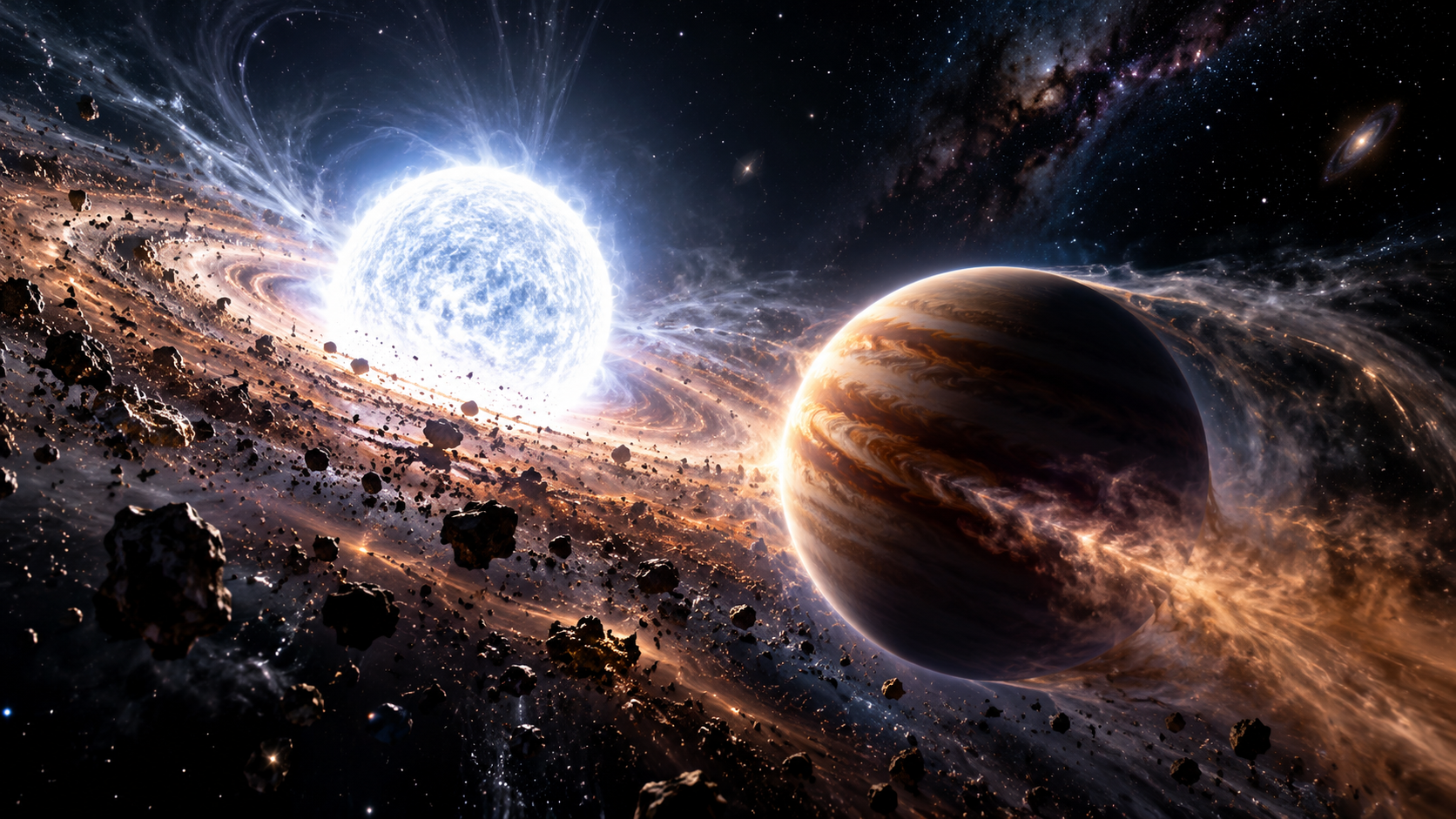
The research suggests that HS 0209+0832 may host a gas giant formed from material expelled during the death of its parent star.
The proposed planet is estimated to be approximately Jupiter-sized.
Observations from NASA's TESS mission revealed periodic brightness variations consistent with an orbiting object. The candidate appears to orbit only about six million kilometres from the white dwarf.
That is much closer than Mercury orbits the Sun.
The white dwarf is still extremely hot, exposing the nearby object to intense radiation. The candidate may consequently be losing its atmosphere, with some of that material escaping into space.
These conditions make the system particularly interesting.
The proposed planet would not simply be orbiting the remnant of a dead star. It may have assembled from matter released during the star's final stages of evolution.
In other words, the material from which planets formed could have been recycled.
But there is an important distinction: the planet's existence and its proposed second-generation origin remain a scientific hypothesis, not a confirmed discovery of a new planetary formation mechanism.
The chemical evidence is intriguing, but more observations are needed to establish how the system formed and evolved.
What Exactly Is a Second-Generation Planet?
To understand why this possibility matters, consider the conventional picture of planetary formation.
First generation: planets born with their star
In a young stellar system, gas and dust orbit a newly forming star.
Small particles collide and accumulate. Over time, they can grow into larger bodies, eventually producing planets, moons, asteroids, and comets.
Earth belongs to this first generation of planetary bodies.
Its ingredients came from the material available when the Solar System formed.
Second generation: planets born after stellar death
Now imagine a different sequence.
A star evolves, exhausts its nuclear fuel, and sheds its outer layers. The expelled material spreads into the surrounding environment, carrying gas, dust, and chemical elements produced during the star's evolution.
Under the right conditions, some of that material could gather into a disk and eventually form a new planet.
The distinction is fundamental.
The first planet forms from the leftovers of a star's birth.
The second may form from the leftovers of a star's death.
This would not mean that every dying star creates new planets. Planet formation requires suitable material, conditions, and enough time for matter to accumulate.
Whether such second-generation planets are common, rare, or exceptionally unusual remains an open question.
Could This Happen to Our Solar System?
Our Sun will not explode as a supernova. Instead, billions of years from now, it is expected to expand into a red giant before shedding its outer layers and leaving behind a white dwarf.
The planets of the inner Solar System will face a very different future from the one they experience today.
Mercury and Venus are expected to be engulfed during the Sun's evolution. Earth's ultimate fate is more complicated, but it will not remain habitable under those conditions.
The outer Solar System will also undergo profound changes.
Could the material expelled by the Sun eventually assemble into new planets?
The discovery surrounding HS 0209+0832 does not establish that this will happen in our Solar System. The conditions around individual stars differ, and the formation of a second-generation planet depends on many factors that researchers are still investigating.
Nevertheless, the possibility raises a fascinating question: could some planetary systems outlive their original architecture by rebuilding themselves from the remnants of stellar evolution?
The answer may depend on how much material survives, how it moves, and whether gravity can organise it into new worlds.
The Universe Recycles More Than We Think
Stars are not merely sources of light.
They are also chemical factories.
Through nuclear reactions and the violent events associated with stellar evolution, stars help produce and distribute many of the elements that eventually become part of planets and living organisms.
The iron in our blood, the calcium in our bones, and many other elements essential to life have cosmic histories extending far beyond Earth.
When stars shed material into space, they enrich the environments from which future generations of stars and planets may emerge.
The possibility of second-generation planets takes this idea one step further.
Perhaps stellar evolution does not only provide the ingredients for new planetary systems. Under certain conditions, it may also provide another opportunity for planets themselves to form.
A planetary system could, in principle, have a history more complicated than a single star surrounded by a fixed collection of planets.
It could be a changing environment shaped by formation, destruction, and renewal.
An Old Telescope, a New Question
One of the most remarkable aspects of this discovery is how it happened.
The original Hubble observations were collected in 1999. Their significance became clearer only when a researcher returned to the data with better chemical information and a new perspective.
The observations had not changed.
Our ability to understand them had.
This is one of the less visible aspects of modern astronomy. Scientific progress depends not only on building more powerful instruments, but also on preserving data, improving analytical methods, and asking questions that previous researchers could not yet answer.
Archives can contain discoveries that have not been recognised because the tools or knowledge needed to interpret them did not exist at the time.
As telescopes collect increasingly detailed observations, the scientific value of older data can continue to grow.
The next breakthrough may already exist in a dataset waiting to be examined.
What We Still Don't Know
The idea of second-generation planets is compelling, but several questions remain unanswered:
- How do these planets form? What physical conditions allow expelled stellar material to gather into a new planetary body?
- How common are they? Is this a rare event, or have we simply been unable to recognise these planets?
- How long can they survive? What happens to a planet orbiting a hot white dwarf as the star gradually cools?
- Could they support life? Even if a planet survives, its origin and orbital environment do not automatically make it habitable.
These questions cannot yet be answered with confidence.
The candidate around HS 0209+0832 provides a reason to investigate them, not a final explanation.
That distinction is what makes the discovery scientifically valuable.
It challenges existing assumptions while leaving room for observation, testing, and revision.
The Beginning After the End
We often describe the life cycle of a star as a story with a beginning, a middle, and an end.
A cloud collapses. A star shines. Its fuel runs out. Its remaining material disperses.
But nature rarely follows the simple narratives we construct for it.
The material released by one generation of stars becomes part of the raw ingredients for the next. Planets can be destroyed, scattered, or transformed. Chemical elements move between stars, gas clouds, and planetary bodies across timescales that dwarf human history.
And somewhere in that complexity, new structures may emerge from what remains of old ones.
The candidate around HS 0209+0832 is not yet proof that planetary systems routinely rebuild themselves after stellar death. It is, however, a compelling reason to investigate whether the end of a star can mark the beginning of a new planetary world.
The Universe does not simply create and destroy. It transforms.
And sometimes, the most interesting discoveries begin when we look at the remains of something that was supposed to be finished.