 NERDICATE
Intermediate
Where Does the Number π Come From?
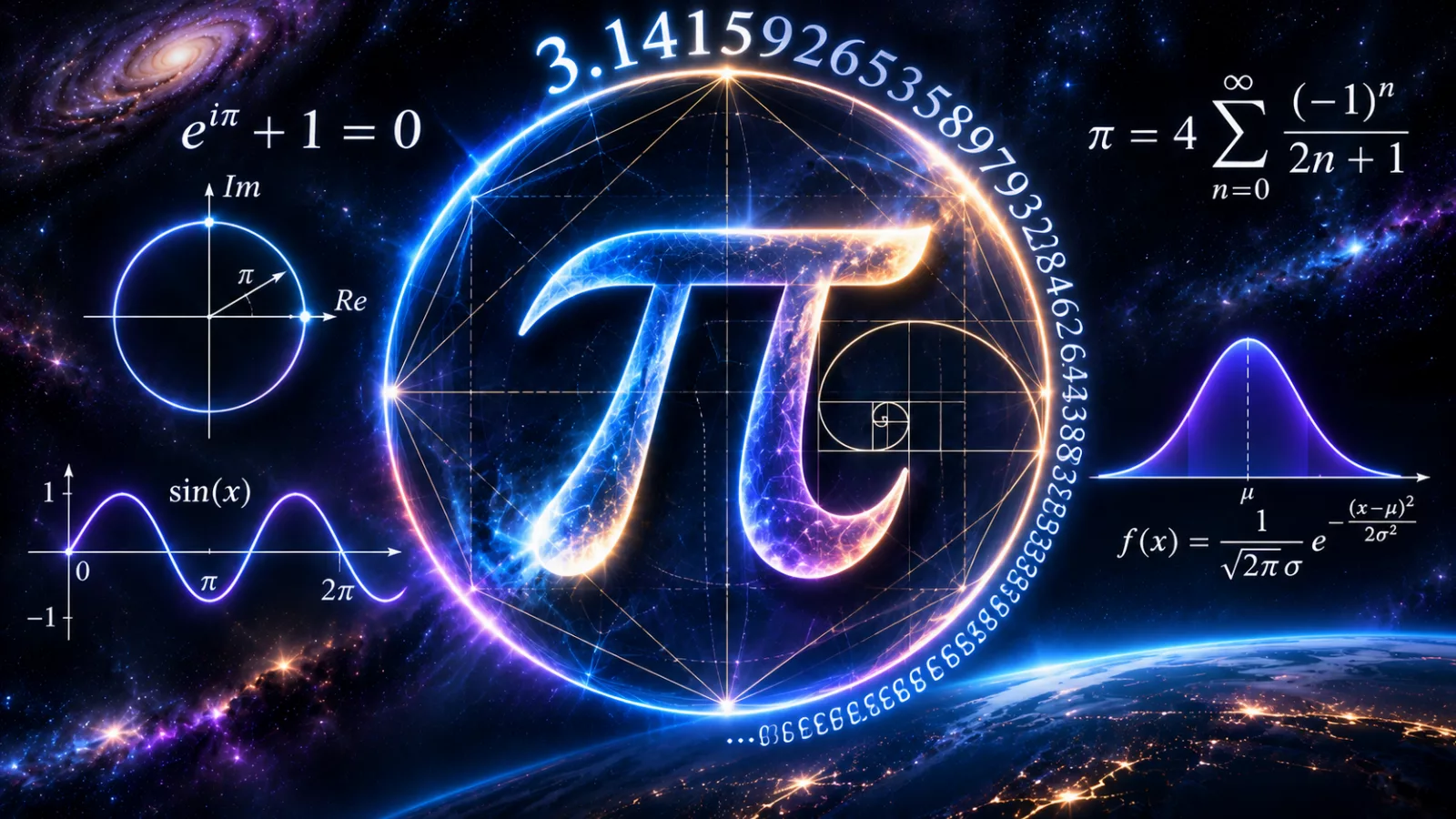
Why does the ratio between a circle’s circumference and diameter always give the same number? And why does π later appear in waves, probability, physics, and Euler’s equation? The story of π begins with geometry, but it quickly turns out that this number is much bigger than the circle itself.
Where Does the Number π Come From?
Excerpt:
Why does the ratio between a circle's circumference and diameter always give the same number? And why does π later appear in waves, probability, physics, and Euler's equation? The story of π begins with geometry, but it quickly turns out that this number is much bigger than the circle itself.
Let's Start With a Circle
Imagine any circle. Small, enormous, drawn on paper, or representing the orbit of a planet. Measure its circumference and then divide it by its diameter.
You will always get the same number:
\pi=\frac{C}{d}
where C is the circumference and d is the diameter.
That is the most basic definition of π.
For every perfect circle, the ratio between these two lengths is constant. It doesn't matter how much we enlarge or shrink the circle. If the diameter doubles, the circumference doubles as well. Their ratio remains unchanged.
Its value is approximately:
\pi\approx3.141592653589793...
And here we encounter the first problem.
The number never ends.
There is no final digit of π. Its decimal expansion does not fall into a repeating pattern either. π is an irrational number.
But before asking why a number associated with circles appears throughout mathematics, we should first see how we can obtain it in the first place.
How Do You Measure Something That Cannot Be Measured Exactly?
Ancient mathematicians obviously did not have calculators capable of displaying trillions of digits of π. They didn't need them.
One approach was to approximate a circle using polygons.
Imagine a polygon inscribed inside a circle. If it has only a few sides, its perimeter is clearly smaller than the circumference of the circle. But as we increase the number of sides, the approximation becomes better and better.
A square can be replaced by an octagon. The octagon by a hexadecagon. Then a 32-sided polygon. And so on.
The more sides we add, the more closely the polygon resembles a circle.
In the limit, we can say that the perimeter of the polygon approaches the circumference of the circle.
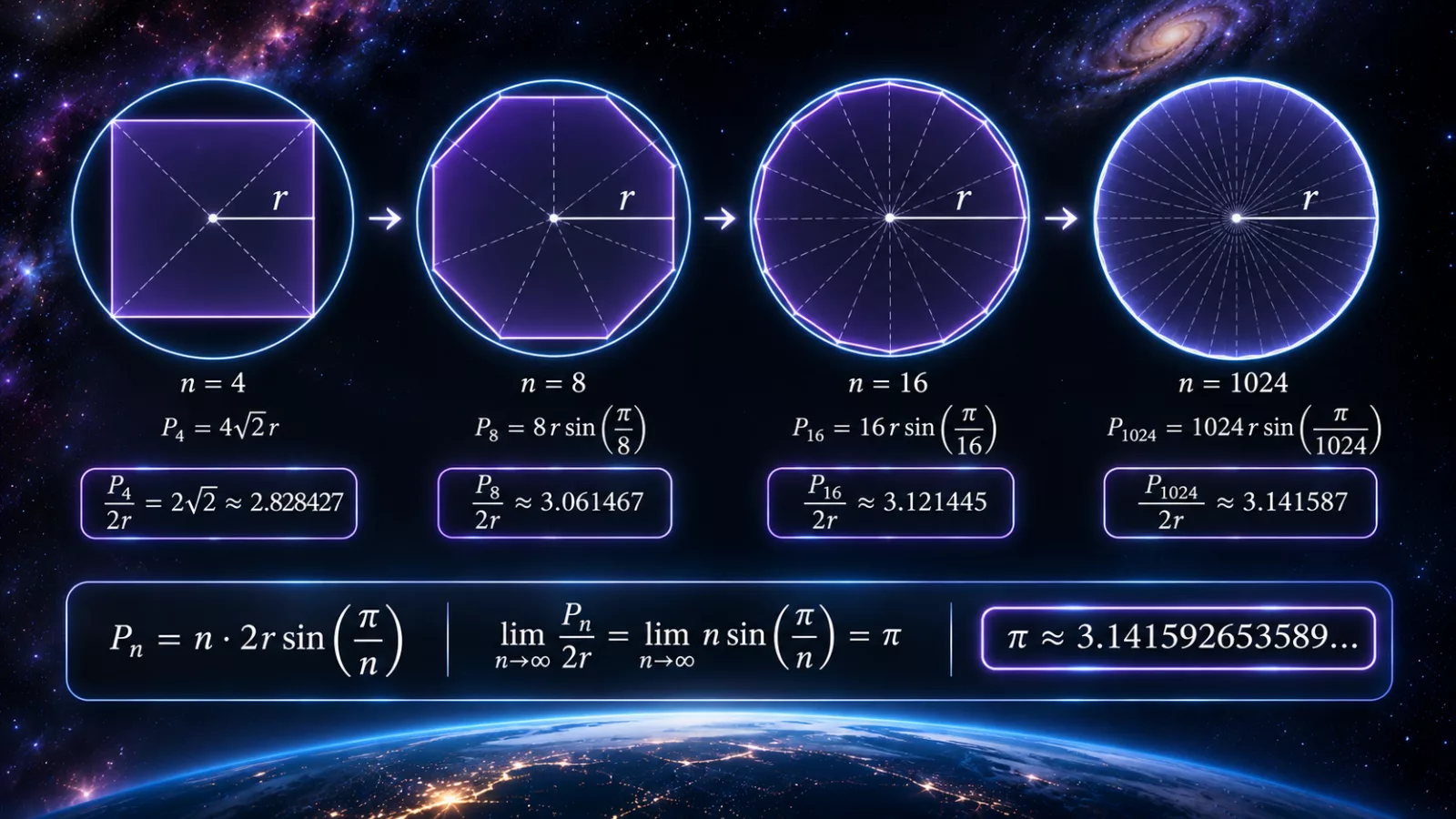
This is one of the first moments when mathematics reveals one of its strange powers: we don't necessarily have to measure an object directly if we can approximate it arbitrarily well.
Archimedes used exactly this idea to establish bounds for π. Instead of trying to “measure” a perfect circle, he trapped its circumference between the perimeters of carefully chosen polygons.
This did not give him all the digits of π, but it allowed him to establish something much more important: π had to lie between specific values.
π Is Not Just a Number for Circumferences
You might think that π is simply a special geometric constant.
And at first, that is exactly what it looks like.
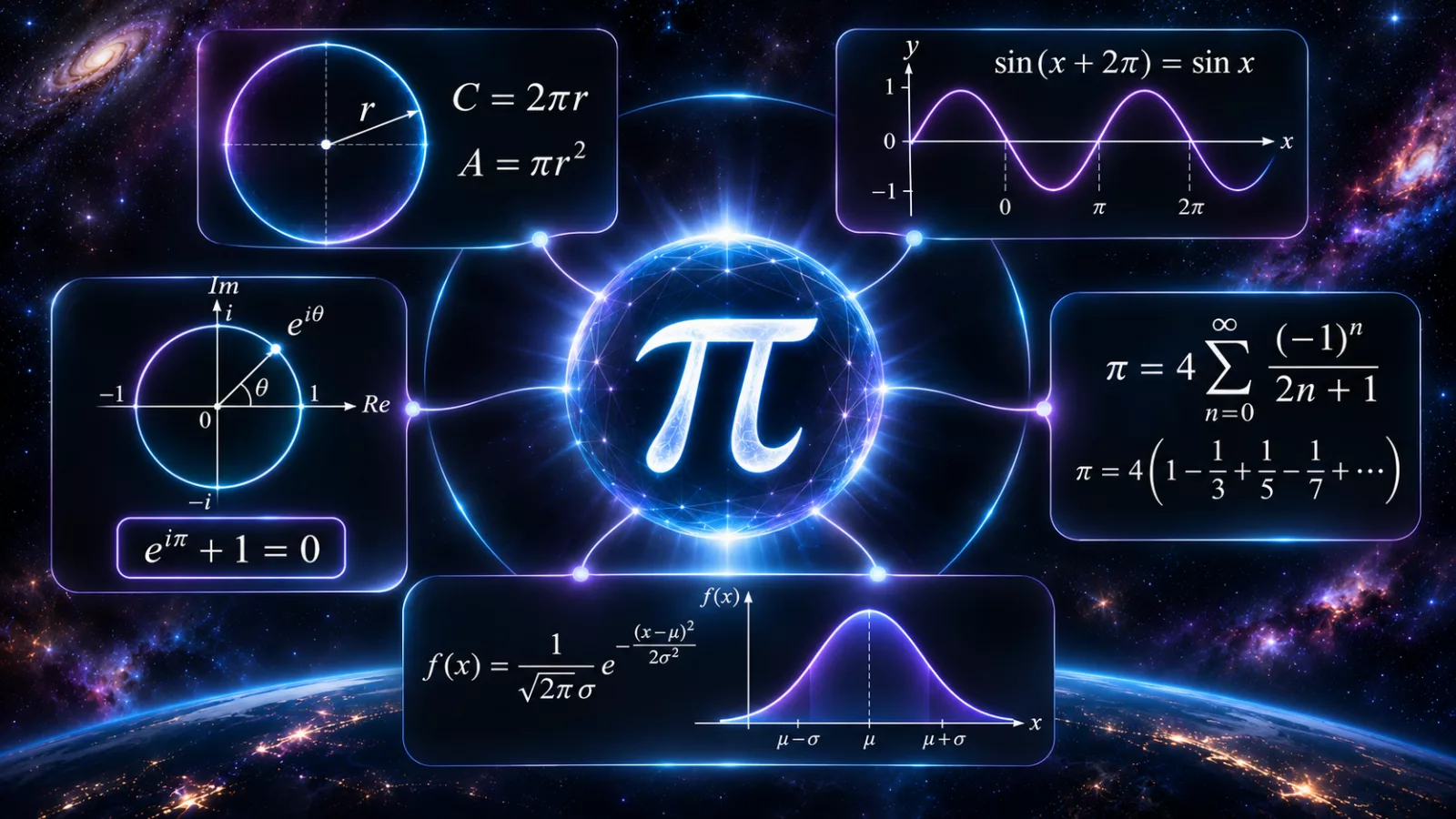
The circumference of a circle is:
C=2\pi r
The area of a circle is:
A=\pi r^2
π appears throughout geometry whenever we start calculating something involving circles.
But then something interesting happens.
Mathematicians begin finding π in places that, at first glance, have absolutely nothing to do with circles.
And this is where π stops looking like a random number from geometry.
Where Does π Come From in the Sine Function?
Consider the sine function.
\sin(x)
There is no obvious circle here. It is simply a function whose graph looks like a wave.
The problem is that sine is directly connected to the geometry of a circle.
Imagine a point moving around the unit circle. If we track its vertical coordinate, we obtain the sine function.
One complete revolution corresponds to the angle:
2\pi
So π naturally appears whenever we describe periodic motion.
That is why sine and cosine have a period of 2\pi:
\sin(x+2\pi)=\sin(x)
After one complete revolution, we return to exactly the same point.
The same mathematics appears in waves, oscillations, sound, electromagnetism, and quantum mechanics.
Suddenly, π is no longer just “the number associated with circles.”
It has become part of the mathematical language of periodicity.
Then Comes Calculus
There are many ways to define π mathematically.
One particularly elegant definition uses an integral:
\pi=2\int_{-1}^{1}\sqrt{1-x^2}\,dx
Why?
The expression
\sqrt{1-x^2}
describes the upper half of the unit circle:
x^2+y^2=1
or:
y=\sqrt{1-x^2}
The integral gives the area beneath this curve — the area of half a circle.
Since the area of the unit circle is π, the area of half of it is:
\frac{\pi}{2}
Therefore:
2\int_{-1}^{1}\sqrt{1-x^2}\,dx=\pi
π has returned to geometry, but this time through calculus.
π Can Even Be Found in an Infinite Series
One of the most famous formulas is:
\frac{\pi}{4} = 1-\frac13+\frac15-\frac17+\frac19-\frac1{11}+\dots
This is known as the Leibniz series.
There is no circle here.
No circumference.
No diameter.
Just fractions being added and subtracted alternately.
And yet the infinite series converges to:
\frac{\pi}{4}
This is a great example of why π is not simply a “property of one particular drawing.”
The same number appears in different mathematical structures because those structures are deeply connected.
The Even Stranger Place: Probability
Now let's make things even stranger.
Take a random point inside a square and ask whether it also lies inside a circle inscribed in that square.
If the square has side length 2, its area is:
A_{\text{square}}=4
The inscribed circle has radius 1, so:
A_{\text{circle}}=\pi
If points are distributed uniformly, the probability of landing inside the circle is:
P=\frac{\pi}{4}
This means we can even estimate π using random points.
If we generate a huge number of random points and count how many fall inside the circle, we obtain the approximation:
\pi\approx4\frac{N_{\text{inside}}}{N_{\text{total}}}
This is a Monte Carlo method.
The more points we generate, the better the statistical estimate becomes — although the convergence toward π is rather slow.
And once again: π has appeared in probability.
Why Does π Appear in the Normal Distribution?
An even more surprising example is the normal distribution.
Its probability density function is:
f(x)= \frac{1}{\sigma\sqrt{2\pi}} e^{-\frac{(x-\mu)^2}{2\sigma^2}}
There is π sitting right there in the denominator.
And it is not there because someone decided that the equation needed a little mathematical decoration.
It emerges from integrating the exponential function of a squared variable.
The key result is:
\int_{-\infty}^{\infty}e^{-x^2}\,dx=\sqrt{\pi}
This result leads directly to the normalization of the normal distribution.
It is one of those beautiful moments in mathematics: a number originally defined through the geometry of a circle appears in statistics describing measurement errors, noise, population distributions, and an enormous range of random phenomena.
π and Complex Numbers
Then we reach one of the most famous equations in all of mathematics:
e^{i\pi}+1=0
Euler's identity connects five fundamental constants:
e,\quad i,\quad\pi,\quad1,\quad0
But why does π appear next to the imaginary unit i?
Because complex numbers allow us to describe rotation.
Euler's formula states:
e^{ix}=\cos x+i\sin x
It connects the exponential function with trigonometric functions.
Set x=\pi:
e^{i\pi} = \cos(\pi)+i\sin(\pi)
Since:
\cos(\pi)=-1
and:
\sin(\pi)=0
we get:
e^{i\pi}=-1
and therefore:
e^{i\pi}+1=0
π appears here because a rotation by π radians is a rotation by 180°.
Geometry, trigonometry, complex numbers, and the exponential function turn out to be different views of the same underlying mathematical mechanism.
So Where Does π Really Come From?
The answer depends on what exactly we mean by “where does it come from?”
If we are asking for the simplest definition, π is the ratio of a circle's circumference to its diameter:
\pi=\frac{C}{d}
If we ask why it appears in calculus, we can find it in integrals and infinite series.
If we ask why it appears in physics and statistics, the answer leads us toward geometry, symmetry, periodic functions, integrals, and probability distributions.
π is therefore not a random number someone invented for circles.
It is a constant that appears wherever mathematics encounters rotation, periodicity, geometry, and certain kinds of symmetry.
π is one of the places where these connections become particularly visible.
And One More Thing: π Never Ends
π is irrational, which means it cannot be written exactly as a ratio of two integers:
\pi\neq\frac{p}{q}
for any integers p and q\neq0.
Its decimal expansion is infinite and non-repeating:
3.1415926535897932384626433832795\dots
That means when we write:
\pi\approx3.14
we are not writing π.
We are writing an approximation of it.
This may look like a small distinction, but mathematically it is fundamental.
There is no “complete decimal representation” of π.
We can only calculate more and more of its digits.
And that is exactly what makes π so fascinating.
It begins with a simple question:
How many times does the diameter fit into the circumference of a circle?
The answer leads to infinite series, calculus, probability, waves, complex numbers, and physics.
Not because π magically appears everywhere.
But because different parts of mathematics are much more deeply connected than their names suggest.
π is one of the places where those connections become impossible to ignore.
One number. Infinitely many digits. And a surprisingly large amount of the universe to describe.
Sources and references
- Web The Number π | Encyclopaedia Britannica britannica.com
- Web Pi | Wolfram MathWorld mathworld.wolfram.com
- Web Pi | NIST Digital Library of Mathematical Functions dlmf.nist.gov
- Web The History of Pi | MacTutor History of Mathematics mathshistory.st-andrews.ac.uk
Enjoyed this one?