
Pilot-Wave Theory: The Return of a Forgotten Quantum Rebel
Can an idea from 1927 still challenge modern physics?
But trajectories.
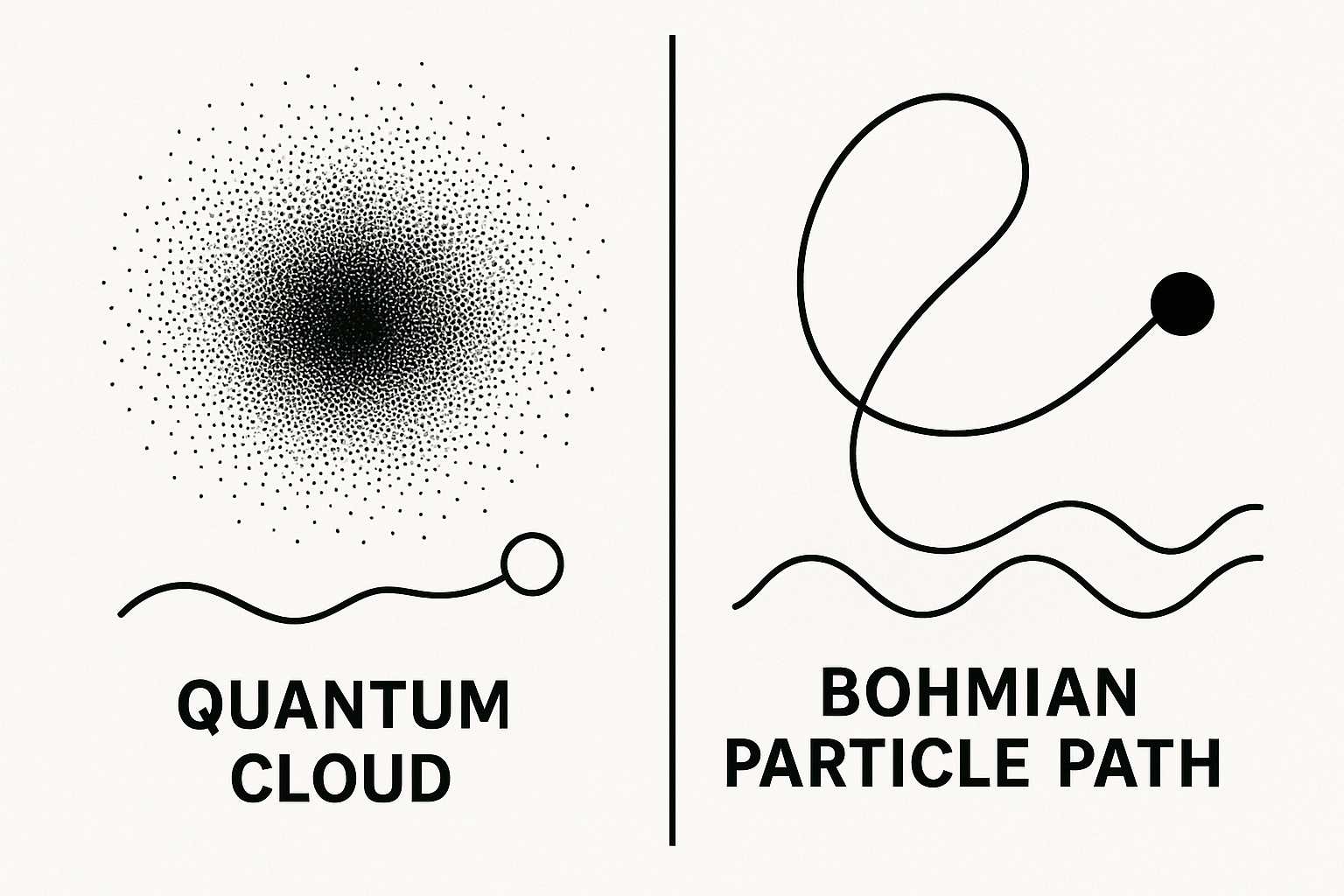
Side-by-side comparison of probabilistic vs. Bohmian particle behavior in quantum theory.
In this picture, particles always have precise positions and follow well-defined paths, guided by an underlying wave structure.
For decades, this idea was pushed aside.
It did not fit the dominant narrative of quantum mechanics, which embraced uncertainty as fundamental.
And yet, the theory never disappeared.
It waited.
Today, it is returning to the conversation. Not as a relic, but as a serious alternative.
The question it raises remains deeply unsettling.
What if randomness is not fundamental, but only apparent?
A Forgotten Path at the Birth of Quantum Mechanics
His proposal was simple.
Particles are real. And they are guided.
A wave evolves according to deterministic laws and directs their motion.
At the Fifth Solvay Conference, the idea was presented to Einstein, Bohr, Heisenberg, and Schrödinger.
The response was cautious.
The Copenhagen interpretation quickly took over.
Under pressure, de Broglie abandoned his own theory.
But the idea did not disappear.
Bohm’s Resurrection: A Deterministic Turn
Assume particles have definite positions at all times.
Assume a guiding wave function evolves according to Schrödinger’s equation.
You recover all quantum predictions.
In this framework, the wave function is not just information.
It acts.
It actively guides particle motion.
There is no collapse. No special role for the observer.
The system evolves continuously.
Deterministically.
The Price of Realism: Nonlocality

Visual representation of quantum nonlocality: two entangled particles interacting across space.
This clarity comes at a cost.Nonlocality.
In Bohm’s theory, the behavior of one particle can depend instantly on another, regardless of distance.
This is what Einstein called “spooky action at a distance.”
But modern physics leaves little room to avoid it.
Bell’s theorem and experiments show that any theory matching quantum predictions must give up either locality or realism.
Bohmian mechanics chooses to keep realism.
And makes nonlocality explicit.
Why Is It Coming Back Now?
Not because of nostalgia.
Because of necessity.
Quantum computing and quantum information are forcing deeper questions.
Foundations are no longer purely philosophical.
They are becoming practical.
In this context, deterministic models are no longer easy to ignore.
Fluid Analogies: When Physics Becomes Visible

Oil droplet bouncing on a vibrating surface, simulating pilot-wave-like behavior.
In 2006, Yves Couder and Emmanuel Fort demonstrated something unexpected.Droplets of oil bouncing on a vibrating surface began to mimic quantum behavior.
Each droplet generated waves that influenced its own motion.
A feedback loop between particle and wave.
The system showed interference, quantized orbits, and tunneling-like effects.
It was entirely classical.
But it looked quantum.
These experiments do not prove pilot-wave theory.
But they make it tangible.
A Legitimate Theory. But Not the Only One
The difference lies in interpretation.
What does the math actually describe?
Science does not only predict outcomes.
It explains reality.
Bohm’s theory offers a continuous, observer-independent picture.
Open Problems and Frontiers
Reconciling it fully with relativity remains unresolved.
Its nonlocal nature is still controversial.
But these are not failures.
They are frontiers.
Philosophical Consequences
A hidden structure beneath observable phenomena.
This idea resonates with modern concepts in quantum gravity and holography.
Whether correct or not, it leads to a clear conclusion.
The standard interpretation is not the only one.
And it may not be the final one.
TL;DR
- Pilot-wave theory describes particles with real trajectories guided by a wave
- David Bohm reformulated it into a deterministic framework
- The theory is nonlocal but preserves realism
- It reproduces all predictions of quantum mechanics
- Interest is growing due to modern quantum technologies
References
- Bohm, D. (1952). A Suggested Interpretation of Quantum Theory in Terms of Hidden Variables. Physical Review.
- Couder, Y., Fort, E. (2006). Single-Particle Diffraction and Interference at a Macroscopic Scale. Physical Review Letters.
- Goldstein, S. (2017). Bohmian Mechanics. Stanford Encyclopedia of Philosophy.
- Holland, P. R. (1993). The Quantum Theory of Motion. Cambridge University Press.
- Valentini, A. (2002). Signal-Locality and the Subquantum H-Theorem.
- Bricmont, J. (2016). Making Sense of Quantum Mechanics. Springer.
Discussion
If quantum mechanics can be explained through deterministic hidden variables, why has indeterminacy become the dominant narrative?

