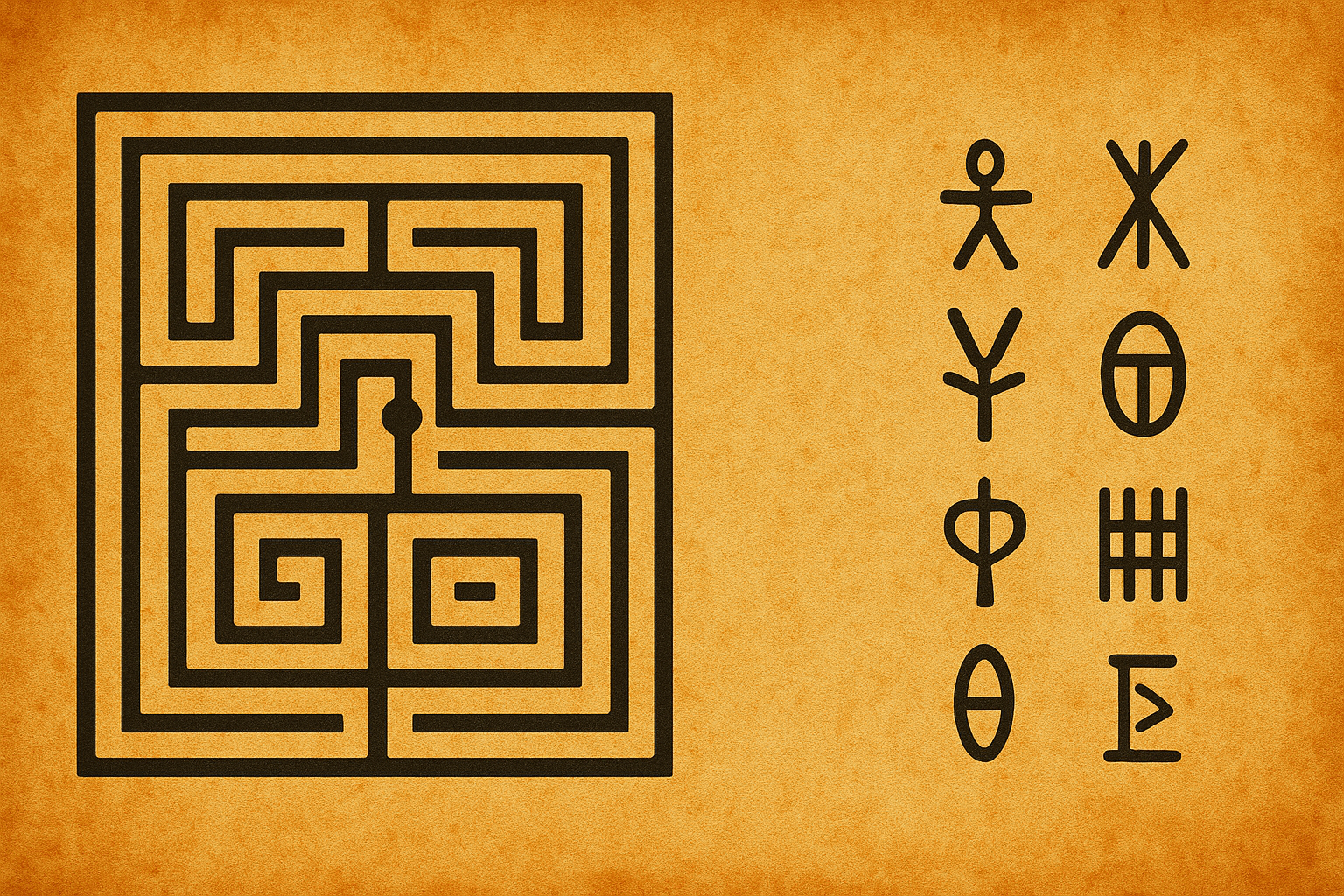
Meander Codes: Can Ancient Labyrinths Hide a Forgotten Cipher?
We tend to see ancient patterns as decoration. But what if some of them were something more, something encoded?
This is the essence of the Meander Code Hypothesis.
Speculative. But surprisingly coherent.
What Is a Meander Pattern?
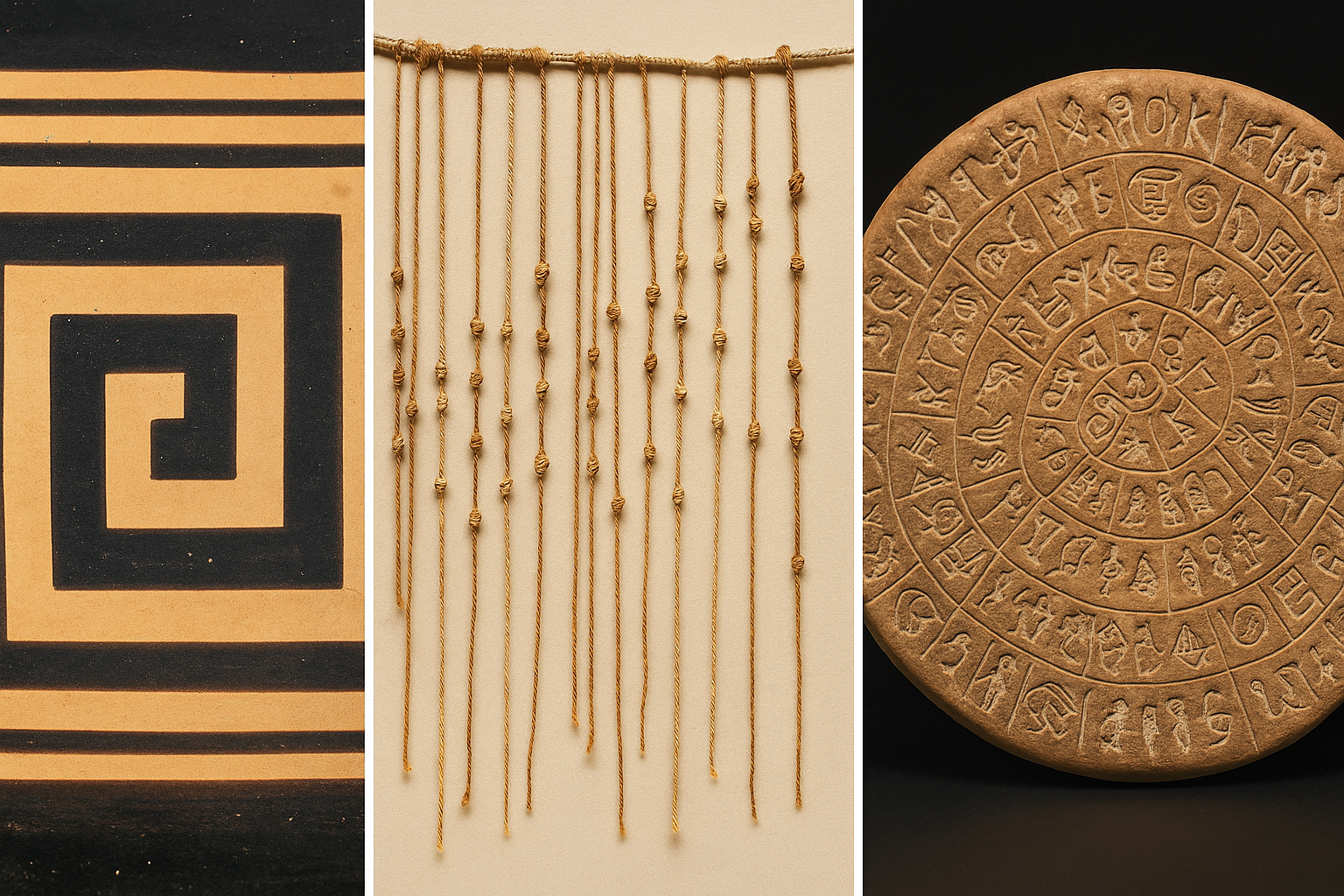
Visual comparison of meander patterns, Inca quipu knots, and the Phaistos Disc as ancient nonverbal information systems.
From classical Greece to Rome and beyond.
Its defining feature is continuity.
The line does not intersect itself.
It folds back in a controlled rhythm, creating a pattern that is both predictable and infinitely extendable.
Traditionally, meanders have been interpreted symbolically.
Eternity. Unity. The winding course of the Meander River.
But none fully explain their persistence.
The question remains.
Why this pattern, everywhere?
Introducing the Hypothesis: Pattern as Code
Small deviations that appear intentional rather than random.
Ancient cultures already used symbolic communication, including steganography and mnemonic systems.
Encoding meaning in form was not a foreign idea.
So the question becomes simple.
What if some patterns carried information?
The Anatomy of a Meander
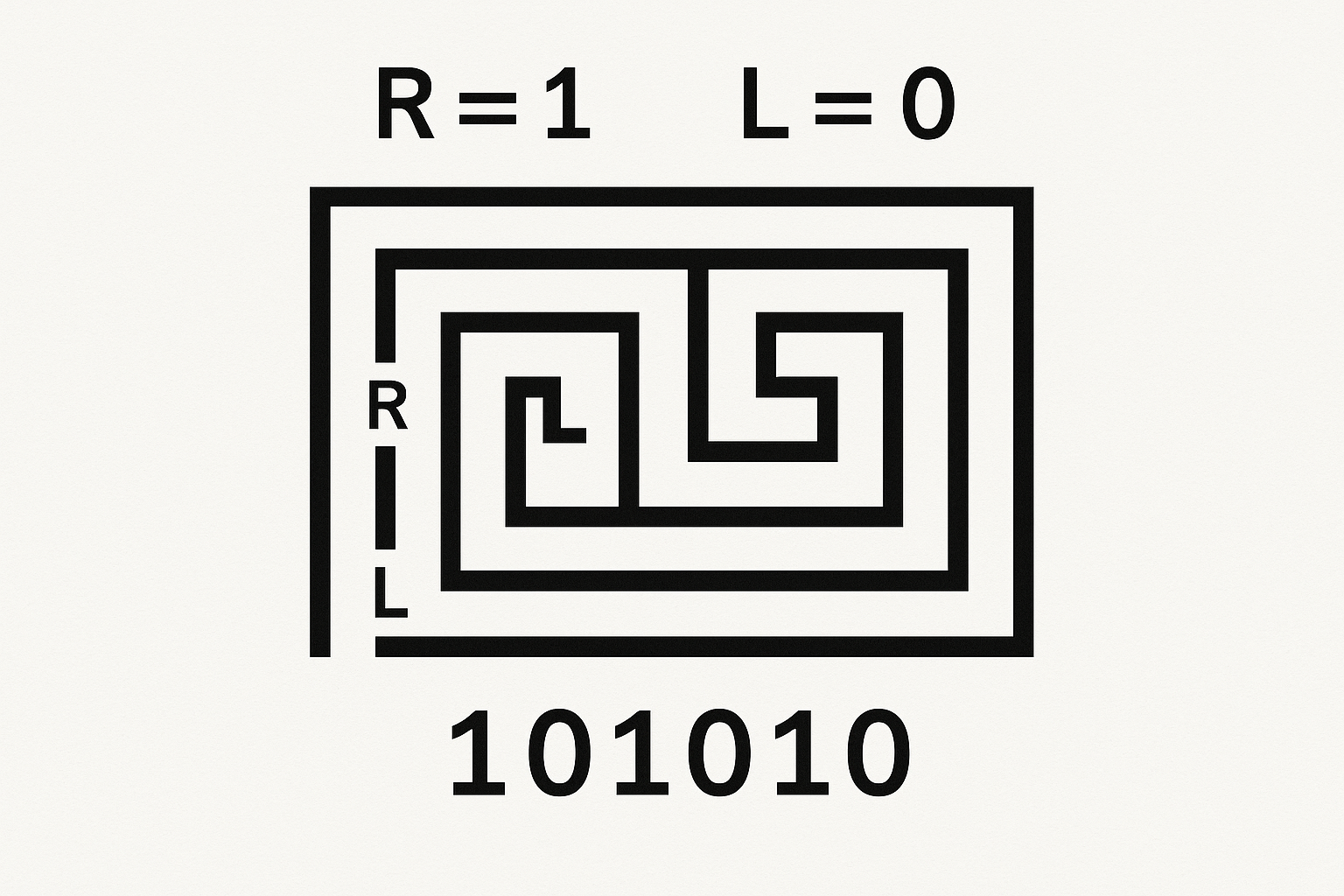
Diagram showing a meander path with binary encoding based on directional turns.
To understand this possibility, the meander must be viewed differently.Not as decoration.But as a system.A path with an entry point, directional turns, repeating segments, and closure.In mathematical terms, this becomes a graph.
Nodes and edges. Decisions and transitions.
Each turn becomes a binary choice.
Left or right.
Sequences become information.
Pattern becomes language.
Meanders and Proto-Encryption
All are possible.
Cultural Clues: Between Ornament and Intention
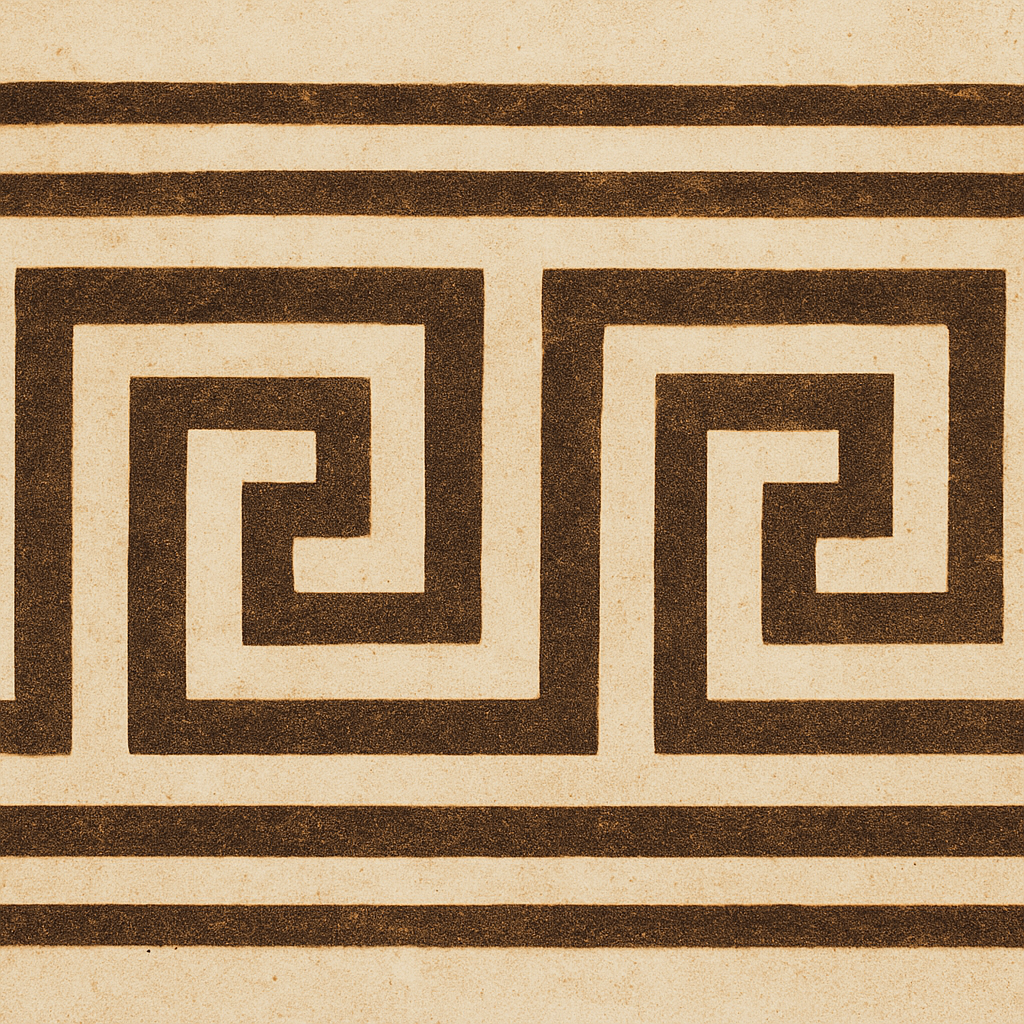
Traditional Greek meander pattern on ancient ceramic or architectural frieze.
Archaeology offers hints.Meanders sometimes include asymmetries within otherwise perfect repetition.Roman mosaics distort patterns near inscriptions.
Etruscan motifs appear in ritual spaces.
Minoan artifacts show structurally similar patterns.
None of this proves encoding.
But it challenges the idea of pure decoration.
Visual Encoding Across Cultures
Counterarguments and Limits
From Ancient Geometry to Modern Cryptography
The past may still inform the future.
Why It Matters
TL;DR
- Meanders are continuous geometric patterns found in ancient art
- The Meander Code Hypothesis suggests some may encode information
- Possible mechanisms include direction, memory systems, and graph structures
- Similar encoding systems exist across multiple civilizations
- The idea is speculative but scientifically testable
References
- Robinson, A. (2007). The Story of Writing. Thames and Hudson.
- Chrisomalis, S. (2010). Numerical Notation. Cambridge University Press.
- Washburn, D., Crowe, D. (2004). Symmetries of Culture. University of Washington Press.
- Fort, E., Couder, Y. (2010). Hydrodynamic analogs of quantum behavior. Nature Physics.
- Renfrew, C., Bahn, P. (2016). Archaeology: Theories, Methods, and Practice.
- Wynn, T., Coolidge, F. (2011). How to Think Like a Neanderthal.
Discussion
If ancient patterns carried meaning beyond decoration, what else are we still failing to decode?

