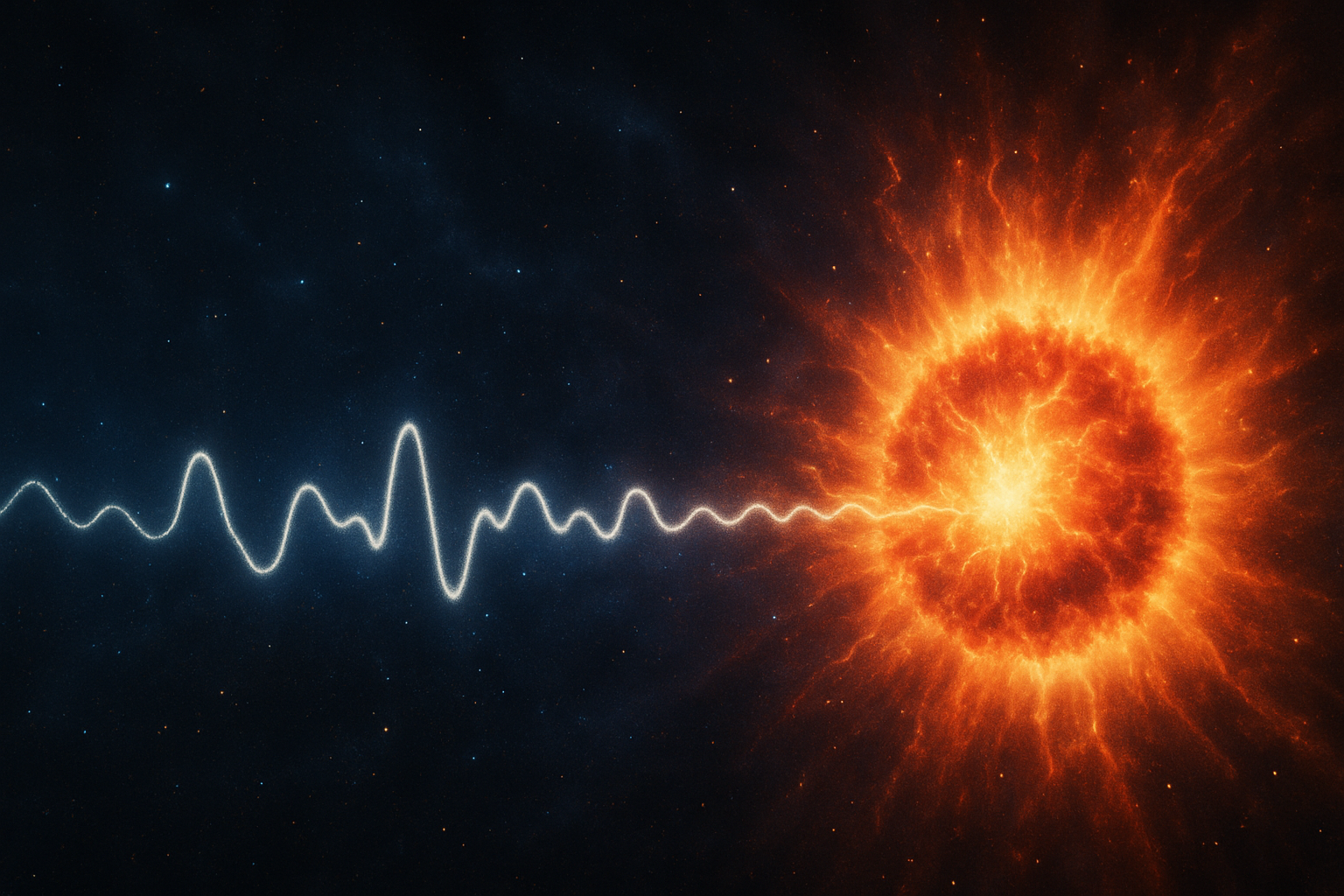
Neutrino Tsunamis: The Ghostly Heartbeat of Type II Supernovae
When a massive star dies, it is not light that carries its final message, but a flood of nearly invisible particles.
Recent models suggest that this emission is not random or uniform.
It unfolds in structured phases, forming a layered, evolving burst often described as a neutrino tsunami.
This phenomenon may encode detailed information about stellar collapse, particle physics, and the internal dynamics of dying stars.
What Is a Type II Supernova?
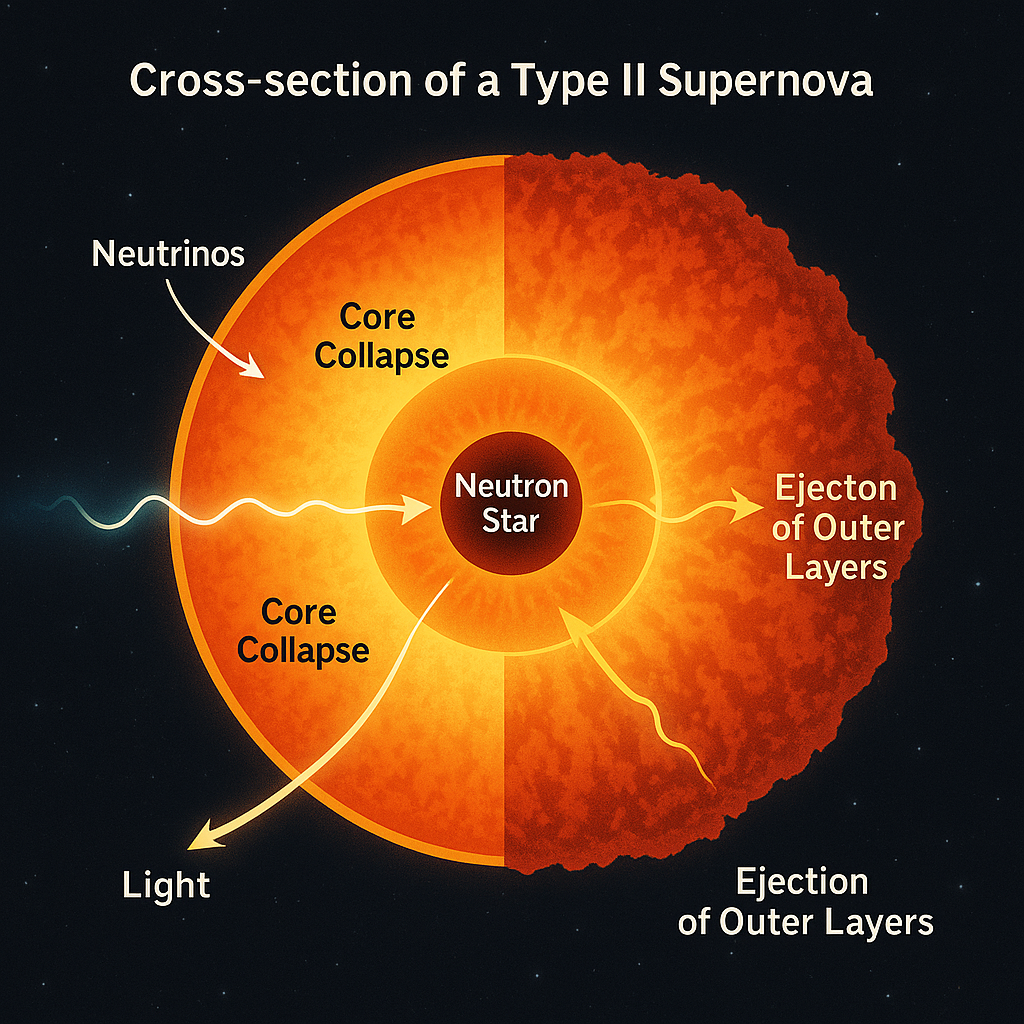
Cross-section of a Type II supernova showing core collapse, neutrino emission, and shockwave propagation.
A Type II supernova occurs when a massive star, typically more than eight times the mass of the Sun, exhausts its nuclear fuel.Without outward pressure from fusion, gravity takes over.
The core collapses in milliseconds, reaching densities comparable to atomic nuclei.
The collapse halts when nuclear forces and neutron degeneracy pressure stiffen the core, producing a rebound shock.
The outer layers fall inward and are then violently expelled.
What we see as a bright supernova is only a fraction of the process.
Most of the energy escapes as neutrinos.
Neutrinos: The True Messengers of Collapse
This releases a burst of electron neutrinos in inverse beta decay.
This initial signal, known as the neutronization burst, lasts only milliseconds.
It is followed by a sustained emission of neutrinos of all flavors as the proto-neutron star cools.
This phase can last more than ten seconds.
Neutrinos record the full timeline of the collapse.
The Neutrino Tsunami
It is structured.
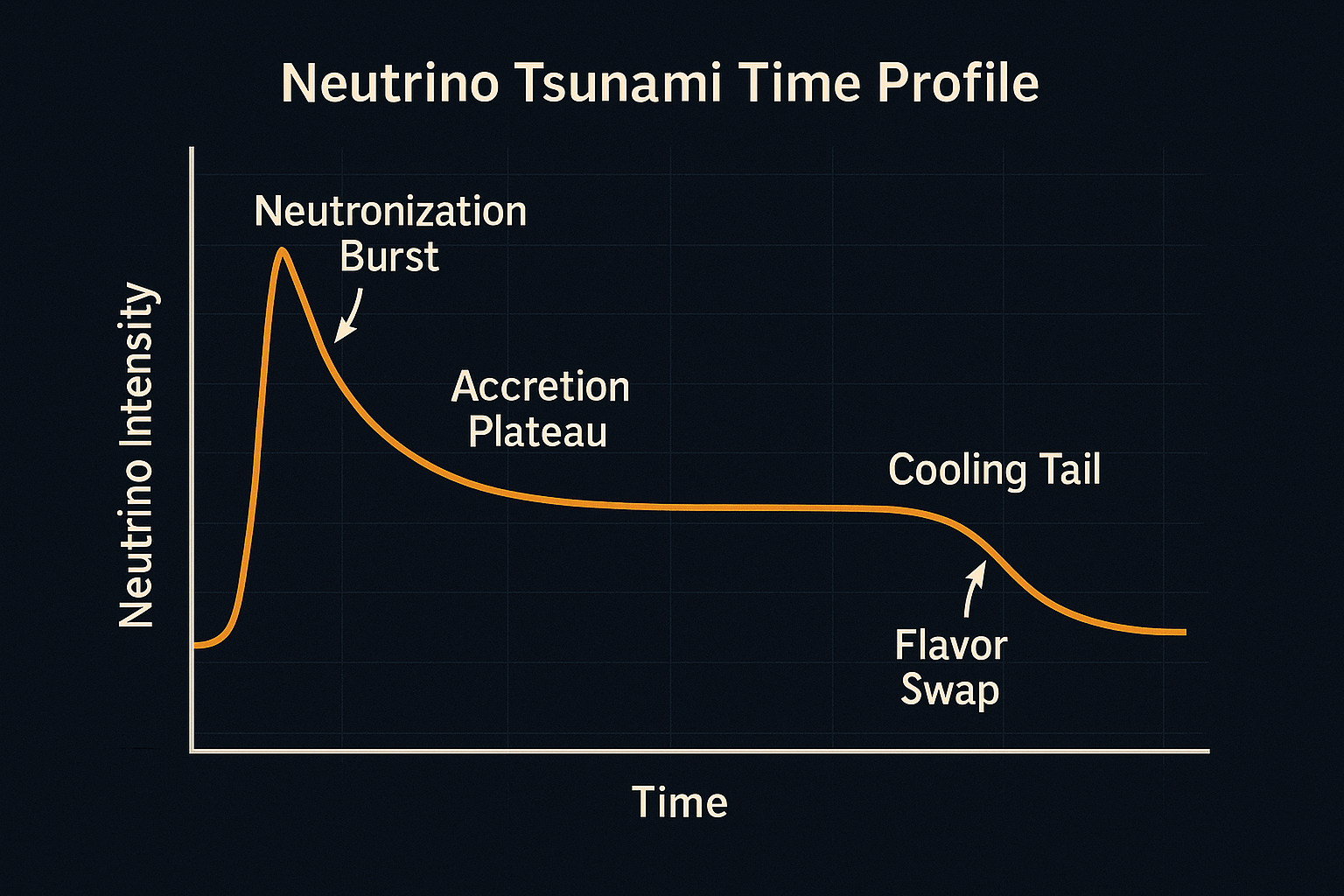
Time profile of neutrino emission during a Type II supernova, highlighting burst, plateau, and decay phases.
It begins with a sharp neutronization peak.
Then comes the accretion phase, where infalling matter feeds the proto-neutron star.
Finally, a cooling phase appears, marked by a gradual decline in emission.
Each phase differs in intensity, energy spectrum, and neutrino composition.
A layered signal moving through space.
Why the Analogy Matters
Most importantly, it arrives before light.
Neutrinos escape immediately, while photons remain trapped.
A nearby supernova would first be detected by neutrino observatories.
Evidence from SN 1987A
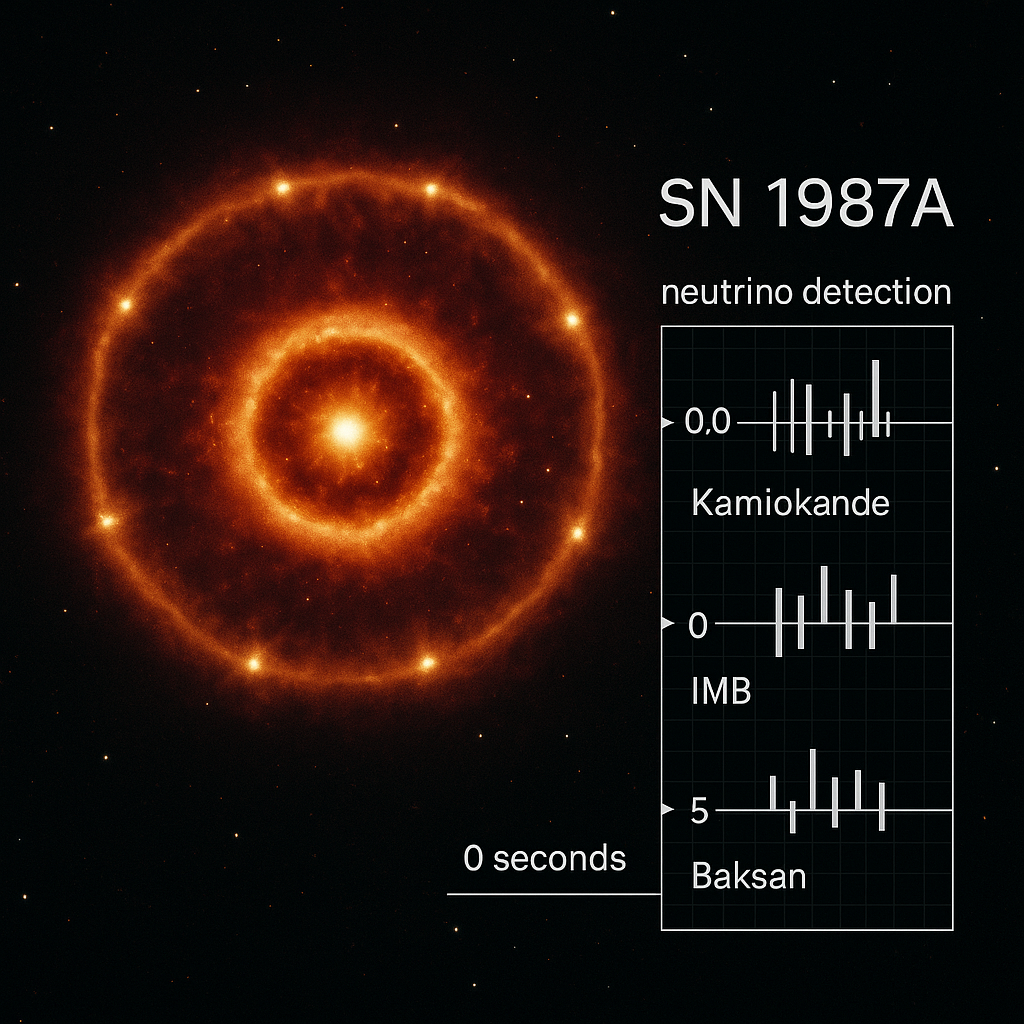
Visual reconstruction of SN 1987A with timeline and neutrino detections in Earth-based observatories.
In 1987, a supernova exploded in the Large Magellanic Cloud.For the first time, neutrinos from such an event were detected on Earth.
Detectors recorded 24 neutrinos over 13 seconds.
Despite the small number, the result was decisive.
Neutrinos arrived before light.
This confirmed theoretical predictions.
Modern detectors are now capable of capturing thousands of events from the next nearby supernova.
Oscillations and Collective Behavior
Inside a supernova, interactions become nonlinear.
Neutrinos influence each other as well as surrounding matter.
This creates collective effects that reshape the signal.
Decoding these patterns could reveal fundamental properties of neutrinos.
Cosmic Implications
Detection systems now act as early-warning networks for stellar explosions.
The Next Nearby Explosion
This would allow full reconstruction of a star’s final moments.
Phase by phase. Signal by signal.
TL;DR
- Type II supernovae release over 99% of their energy as neutrinos
- Emission occurs in structured phases called a neutrino tsunami
- These signals encode information about stellar collapse
- Neutrinos arrive before light and act as an early warning
- Future detections may transform astrophysics
References
- Janka, H.-T. et al. (2007). Theory of Core-Collapse Supernovae. Physics Reports.
- Mirizzi, A. et al. (2016). Supernova Neutrinos. Rivista del Nuovo Cimento.
- Duan, H. et al. (2010). Collective Neutrino Oscillations. Annual Review of Nuclear and Particle Science.
- Hirata, K. et al. (1987). Observation of a Neutrino Burst from SN 1987A. Physical Review Letters.
- Scholberg, K. (2012). Supernova Neutrino Detection. Annual Review of Nuclear and Particle Science.
Discussion
If the next nearby supernova sends neutrinos before the sky changes, will we know how to read the signal?

