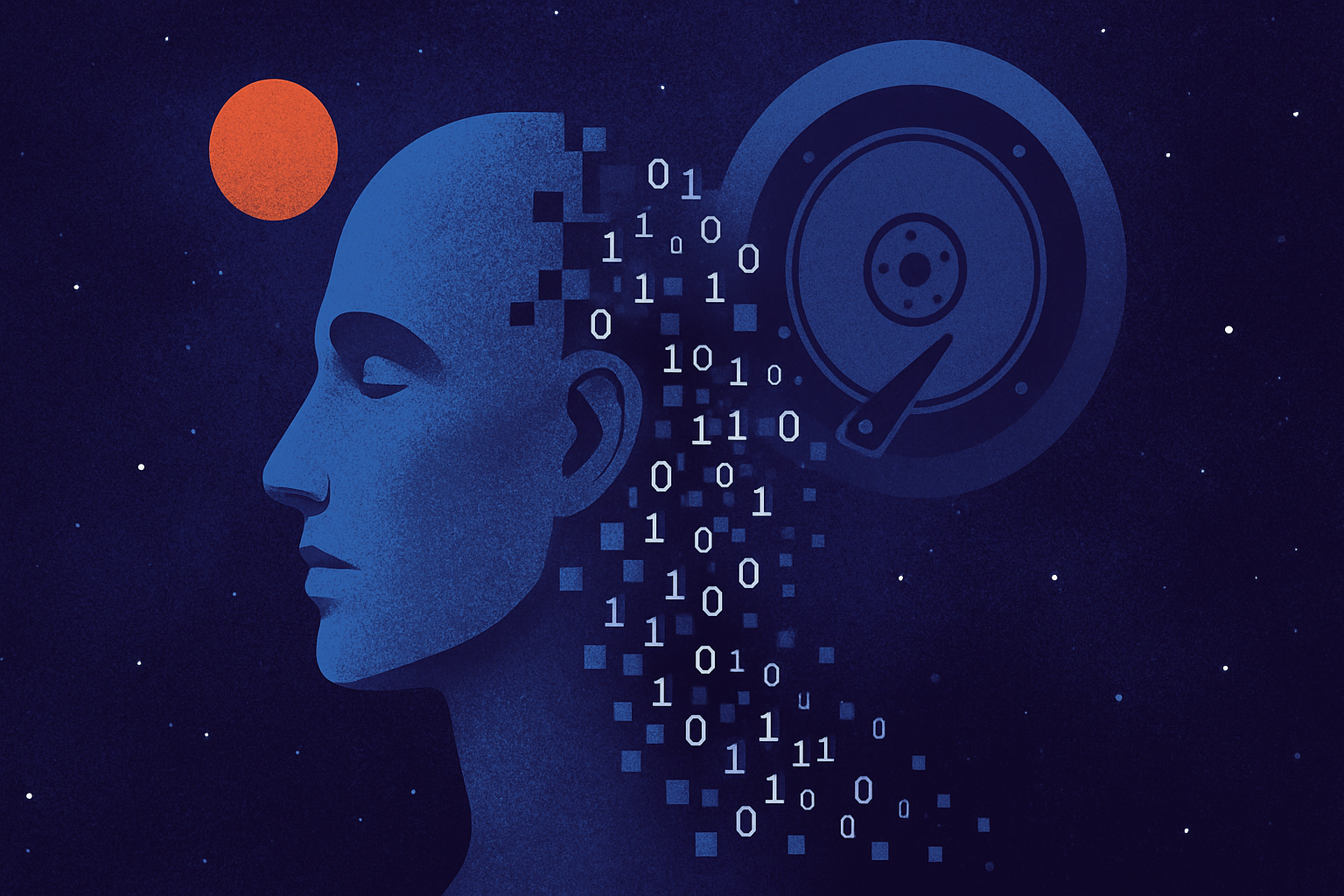
Digital Immortality: Can You Back Up a Soul?
What if the final backup isn’t for your files… but for your mind?
The question is no longer simply whether we can upload a brain.
It is far more unsettling. What does it mean to survive in data?
If we recreate your memories, your voice, your habits, even your sense of humor, do we get you?
Or something that only looks like you from the outside?
We live in an era where memory is externalized. Phones remember what we forget. Photos outlive our presence. Data accumulates faster than identity can stabilize.
But turning a person into a digital entity is not an upgrade in storage.
It is a shift from archiving to becoming.
And unlike a file, there is no undo button for the self.
The Dream: Escaping Biology
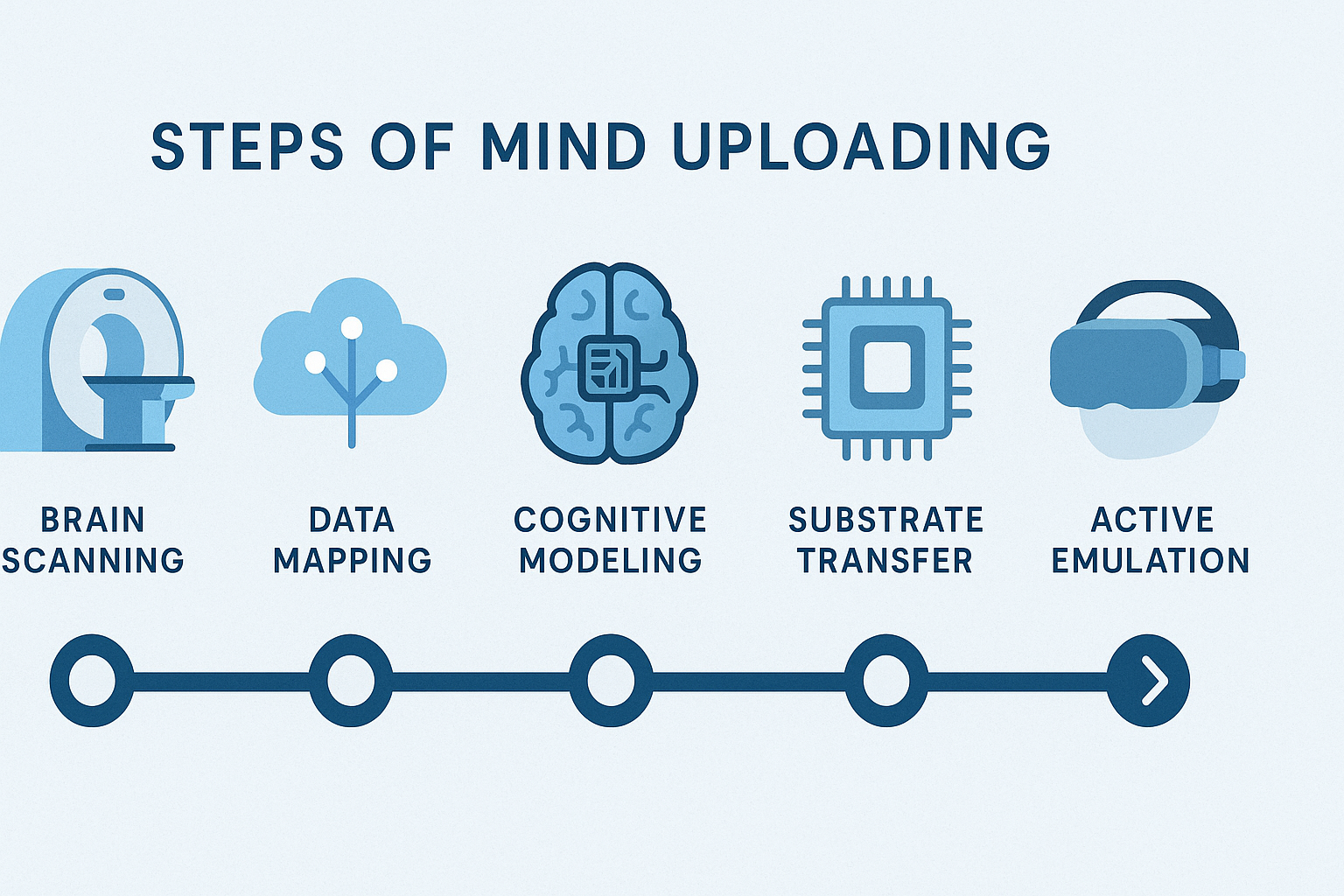
Uploading a mind isn’t magic. It’s a brutal technical roadmap.
Immortality has always been part of human imagination. In ancient myths, it came through gods, rituals, or magical objects.Today, it arrives in the language of computation. Neural scans, data structures, and machine learning models.
Projects ranging from brain-computer interfaces to full connectome mapping suggest a future where the brain is no longer a mystery, but a system. Complex, but potentially reproducible.
At the center of this vision lies a radical proposition.
If the brain is a pattern, it could be copied.
A dynamic network of electrical and chemical activity translated into code and executed elsewhere.
This is the idea behind mind uploading.
Scan the brain at sufficient resolution. Reconstruct its structure. Run it on a sufficiently powerful system.
The result would not be symbolic continuation.
It would claim to be you.
Critics remain unconvinced. Copying a brain is not like copying a file.
It is closer to capturing a flame.
You may reproduce its shape.
But whether you preserve its essence remains an open question.
The Science: Mapping the Mind
Modern neuroscience has made remarkable progress in mapping these structures.
Large-scale projects are beginning to reconstruct neural pathways and identify functional regions with increasing precision.
Yet what we currently possess is not a full understanding.
It is a partial map.
A structural outline without complete access to the dynamics that bring it to life.
Even if we could capture every connection, we would still face a deeper problem.
The brain is not static.
It is a process.
Continuously changing. Influenced by the body, the environment, and time itself.
A map may describe the terrain.
But it does not become the terrain.
The Copy Problem
It speaks like you. Remembers your past. Reacts as you would.
But is it you?
This is where the problem shifts from engineering to philosophy.
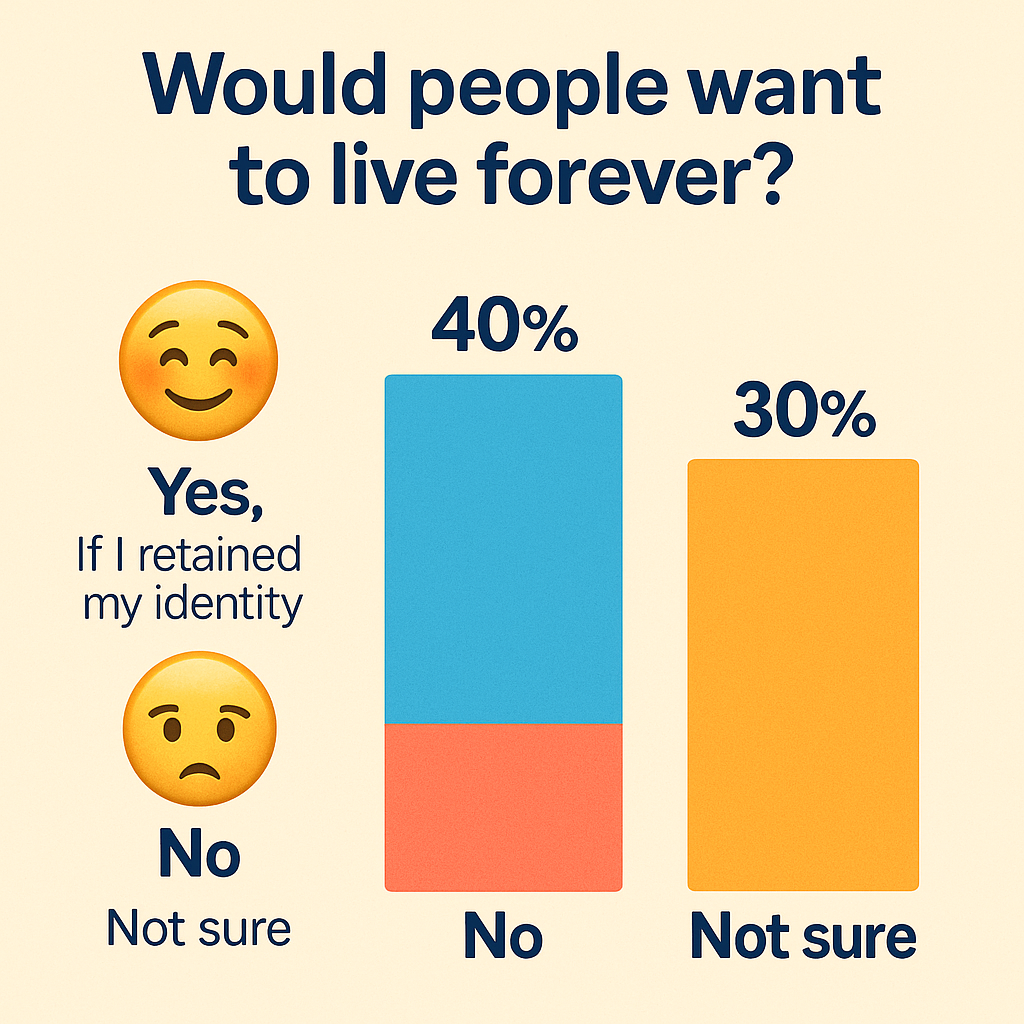
Do we really want to live forever? The answer isn’t as clear as you’d think.
A perfect copy may behave identically, but identity is not only about behavior.
It is about continuity.
The uninterrupted experience of being.
If a copy exists alongside the original, then both cannot be the same individual.
At best, they share a past.
From that moment on, they diverge.
Substrate Matters
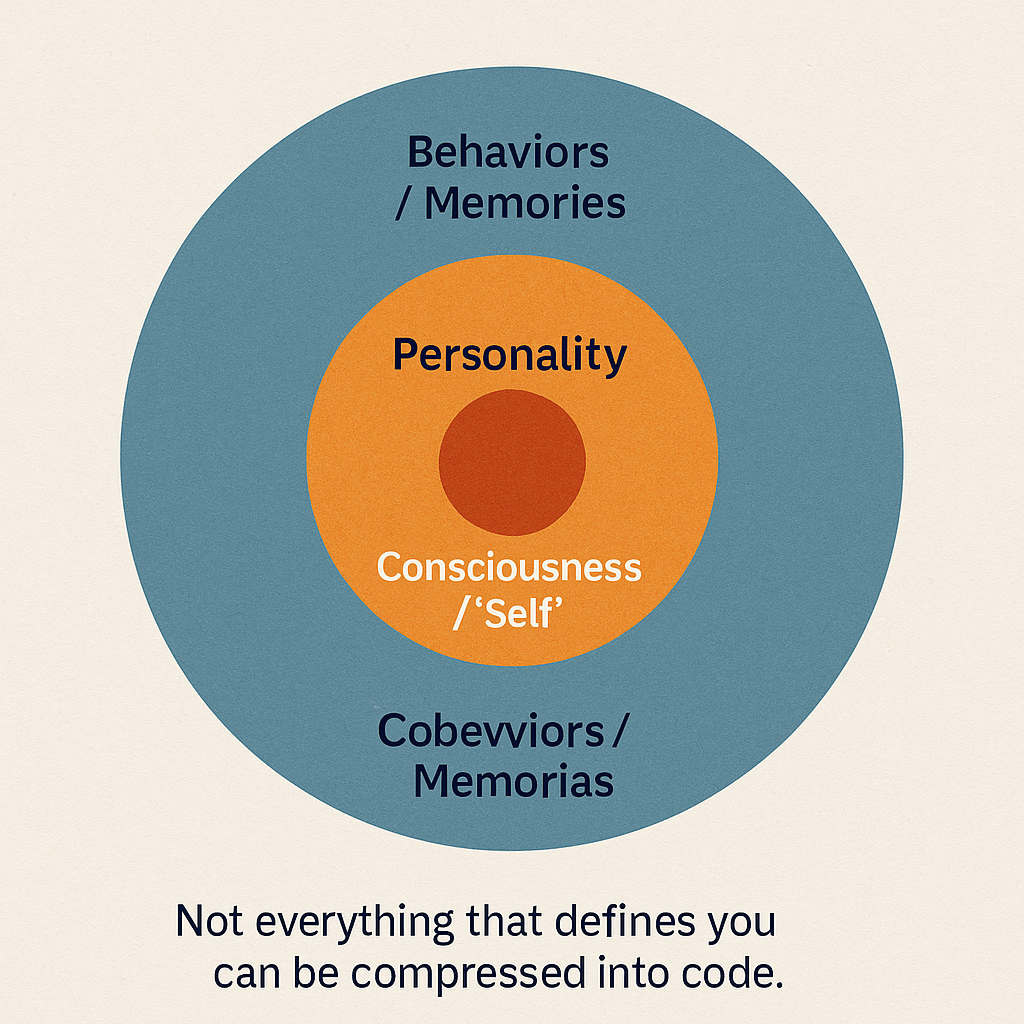
What makes “you”… you? Identity might be more than just memory.
A deeper question lies beneath the technical challenge.Does consciousness depend on the medium?
The brain is not simply an information processor. It is a biological system shaped by chemistry, electricity, and evolution.
Digital systems operate differently. They simulate processes, but simulation is not necessarily instantiation.
Some argue consciousness is substrate-independent.
Others argue the opposite.
We currently have no way to test either.
Continuity and Identity
Which one is you?
From the outside, both appear valid.
From the inside, only one continues the original experience.
Identity may not be a thing.
It may be a process.
Something that unfolds, not something that can be copied.
Ethics of Immortality
Can it be copied, modified, or deleted?
Immortality, if it exists, may not be equally accessible.
And history suggests who will control it.
A New Kind of Legacy
Instead of being remembered, a person could remain present.
Interacting. Responding. Existing.
This transforms legacy into participation.
But it raises a final question.
Is persistence the same as existence?
To live on as data may not mean to continue as a self.
It may mean becoming something else entirely.
A pattern that endures, but no longer experiences.
Digital immortality is not about defeating death.
It is about redefining what it means to be alive.
TL;DR
- Digital immortality explores the idea of uploading human consciousness
- Technically plausible in theory, but not yet achievable
- The core problem is identity, not storage
- A perfect copy of your mind may not be you
- The question is philosophical as much as scientific
References
- Kurzweil, R. (2005). The Singularity Is Near.
- Metzinger, T. (2010). The Ego Tunnel.
- Koene, R. A. (2012). Substrate-independent minds.
- Hayworth, K. (2012). Neural circuit mapping research.
- Bostrom, N. (2003). Are You Living in a Computer Simulation?
- Roache, R., Savulescu, J. (2014). AI and the future of the mind.
Discussion
If a perfect copy of your mind can exist… would you trust it to be you?