The Hidden Energy Inside Black Holes
What if the ultimate battery isn’t what falls in… but what it already stores?
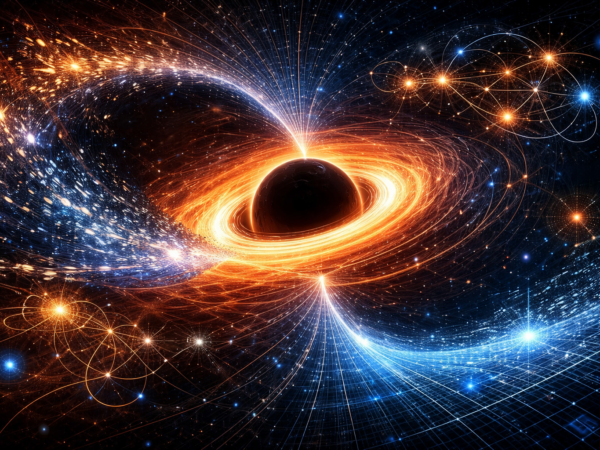
Black holes are not just cosmic voids.
They are energy storage units with hidden reserves.
When we picture a black hole, we imagine emptiness behind a boundary.
Mass.
Light.
Time.
Sucked in.
Trapped.
Dead.
But modern physics tells a very different story.
Black holes contain immense energy that is not locked away.
It is structured and extractable.
Not by magic.
By geometry, thermodynamics, and quantum mechanics.
The hidden energy inside black holes comes in three forms:
- Rotational energy (spin),
- Electromagnetic energy (charge),
- Thermal and quantum energy (Hawking-style).
And we are starting to understand how to tap into all of them.
Why Black Holes Are Energy Reservoirs
A black hole is defined by its mass, spin, and charge.
Everything else washes out — the famous no-hair theorem.
But those three properties encode vast reservoirs of energy.
Mass means rest energy:
E = M c².
Spin means rotational energy:
Up to ~29% of the mass-energy stored in rotation for a maximally spinning Kerr black hole.
Charge means electrostatic energy:
Field lines trapped in the geometry, ready to push and pull.
That is not small.
A stellar-mass black hole has more energy than all the stars in a galaxy combined.
Even a supermassive black hole with 10⁹ M☉ is a device that already contains colossal stored energy at its core.
The only challenge is:
How do you access it?
The Ergosphere and the Penrose Process
The first serious hint that black holes store usable energy came from Roger Penrose in 1969.
He realized something strange about rotating (Kerr) black holes:
Outside the event horizon lies the ergosphere, a region where spacetime is dragged so strongly by rotation that nothing can stay still.
In this frame-dragged zone, Penrose found a loophole.
If a particle enters the ergosphere and decays into two fragments,
one of them can fall into the black hole with negative energy relative to infinity,
while the other escapes with more energy than the original particle had.
The black hole pays the bill.
Its mass and angular momentum decrease.
Its spin slows.
That trick is the Penrose process.
On paper, you can extract up to ~29% of a black hole’s mass as rotational energy.
For a rapidly spinning black hole, that is far more efficient than nuclear fusion.
And it does not involve going inside the horizon.
It happens in the twisting space around it.
This is the first concrete proof that black holes are not sinks.
They are energy systems with taps.
Superradiance: Waves That Steal Rotation
A related mechanism is superradiance.
When a wave (light, electromagnetic, or even gravitational) hits a rotating black hole,
it can be amplified, not absorbed.
If the frequency matches the right band,
the wave comes out stronger, while the black hole loses mass and angular momentum.
This is rotational superradiance.
For charged black holes, there is charged superradiance.
In effect, the black hole radiates useful energy at the expense of its rotation.
Superradiance is not just a curiosity.
It may be relevant for:
- Black hole explosions,
- Unstable modes around Kerr black holes,
- Future energy-extraction geometries.
The lesson is the same:
black holes store rotational energy, and spacetime itself can help us harvest it.
The First Law of Black Hole Thermodynamics
The full picture came with black hole thermodynamics.
Jacob Bekenstein and Stephen Hawking linked geometry to entropy and temperature.
Bekenstein suggested that black holes have entropy proportional to horizon area.
Hawking showed they have temperature and emit Hawking radiation.
Together, this leads to the first law of black hole thermodynamics:
dM = (κ/8π) dA + Ω dJ + Φ dQ
Where:
- M = mass-energy,
- κ = surface gravity (temperature-like),
- A = horizon area (entropy-like),
- Ω = angular velocity,
- J = angular momentum,
- Φ = electric potential,
- Q = charge.
This looks suspiciously like the first law of thermodynamics:
dE = T dS + “work terms”.
So a black hole is not just a lump of mass.
It is a thermodynamic system with:
- Temperature,
- Entropy,
- Energy,
- Work terms tied to spin and charge.
In that language, all three forms are usable energy.
Hawking Radiation as a Slow Energy Leak
The most famous way black holes “lose” energy is Hawking radiation.
Virtual particle-antiparticle pairs near the horizon become real,
with one escaping to infinity and the other falling in with negative energy.
The escaping particle carries positive energy away.
The black hole’s mass decreases.
For stellar or supermassive black holes, this process is excruciatingly slow.
It might take 10⁶⁰–10¹⁰⁰ years for a black hole to evaporate.
But in principle, all of its mass can be turned into radiation.
Hawking’s insight is that black holes are not eternal prisons.
They are long-term batteries that slowly unload their energy as heat.
And that means even a non-rotating, non-charged black hole hides thermal energy in its geometry.
Charged Black Holes and Electric Penrose Processes
Rotational energy is not the only option.
Charged black holes (Reissner–Nordström and Kerr–Newman)
can release energy through their electric fields.
An electric Penrose process uses Coulomb interactions in a generalized ergoregion.
If a charged particle splits or scatters in the right way,
it can escape with more energy than it came in with,
while the black hole loses mass and charge.
Recent work (2026) on electric Penrose energy extraction shows that:
- Efficiency depends on charge, spacetime geometry, and quantum effects,
- Certain configurations allow high-efficiency transfers.
This is the electromagnetic version of the Penrose trick.
The energy is not in the matter.
It is in the field geometry the black hole sustains.
Quantum Energy Teleportation and Controlled Hawking Links
A more speculative but exciting idea is quantum energy teleportation (QET).
In ordinary quantum teleportation, you transfer quantum information using entanglement and classical communication.
In quantum energy teleportation, you transfer energy using entanglement and local measurements.
2025–2026 work on QET near black holes suggests that:
- Measurements of quantum fluctuations near the horizon can be used to trigger local energy extraction,
- The black hole’s mass decreases as positive energy is extracted outside.
This is a controlled version of Hawking radiation.
Instead of waiting for random emission,
you use quantum correlations to steer the energy flow.
It is still theoretical.
But it points to a deep fact:
the quantum vacuum around a black hole is not empty energy.
It is a structured reservoir that can be addressed and read out.
Magnetized Holes and the Magnetic Penrose Process
Another twist comes from magnetic fields.
When a black hole sits in a strong magnetic field,
its rotation can drive powerful electromagnetic currents in the surrounding plasma.
The Blandford–Znajek mechanism and related ideas show that:
- Magnetic fields thread the ergosphere,
- Twisted by rotation,
- They launch jets and Poynting fluxes that carry energy away.
Some 2026 work on the Magnetic Penrose Process in extended gravity theories (Horndeski, etc.)
explores how geometry and magnetic fields together can boost energy-extraction efficiency beyond the classical Penrose limit.
In effect, the magnetic field acts like a catalyst.
It turns the black hole’s rotation into electromagnetic power.
Could We Actually Use This Energy?
Practically, extracting energy from black holes remains science-fiction-adjacent.
But let’s be honest:
- We already extract energy from matter falling inward (accretion disks),
- Jets and radiation are free-range energy from the black hole’s environment.
If we survive long enough as a civilization, engineering with gravity and magnetism at galactic scales may not be absurd.
Three realistic future scenarios:
- Penrose-style power plants
Humans or probes send carefully prepared masses into the ergosphere.
The outbound fragments carry the energy.
The black hole spins down over time. - Superradiant amplifiers
Tuned waves (radio, gravitational, laser) bounce off the horizon region,
amplified by the hole’s rotation and charge.
You mine rotational energy with waves instead of matter. - Quantum-vacuum power
In the far future, humanity could design systems that stabilize and harness vacuum modes near horizons,
using quantum energy teleportation-like tricks to extract thermal energy on demand.
Black holes would not be “destroyed.”
They would be devices.
The Philosophical Flip
The deepest shift here is conceptual.
We used to think:
Black holes swallow energy.
Their gravity is purely destructive.
We now know:
Black holes store energy in multiple forms.
Their geometry allows energy extraction.
Their quantum vacuum can be tapped.
They are less like cosmic sinks,
and more like astronomical batteries powered by spacetime itself.
So the hidden energy inside black holes
is not a secret.
It is a feature of general relativity and quantum fields.
And that means the universe may already be hosting the most extreme power sources in existence.
We just need to learn how to read the address label on their event horizons.
TL;DR
- Black holes hide enormous energy reserves in their mass, spin, and charge.
- The Penrose process lets us extract rotational energy from the ergosphere without crossing the horizon.
- Superradiance and wave-amplification mechanisms allow energy extraction through rotating or charged fields.
- Hawking radiation turns black holes into long-term thermal batteries that slowly release their mass.
- Charged black holes enable electric Penrose processes and electric-field-based extraction.
- Quantum energy teleportation (QET) suggests controlled energy extraction via vacuum correlations.
- Magnetized black holes can convert rotation into electromagnetic power.
- Black holes are not just cosmic voids — they are ultimate energy systems.
References
- Hawking, S. W. (1974). Black hole explosions? Nature.
- Penrose, R. (1969). Gravitational collapse: The role of general relativity. Rivista del Nuovo Cimento.
- Misner, C. W., Thorne, K. S., & Wheeler, J. A. (1973). Gravitation.
- Bekenstein, J. D. (1973). Black holes and entropy. Physical Review D.
- Bardeen, J. M., Carter, B., & Hawking, S. W. (1973). The four laws of black hole mechanics. Communications in Mathematical Physics.
- Rees, M. J., et al. (1978). Magnetohydrodynamic processes near rotating black holes and in accretion discs.
- Recent papers on Electric Penrose energy extraction and Quantum Energy Teleportation (2025–2026, arXiv/emergent-mind).