Chaos Theory Is Now Used to Predict Real-World Systems
What if perfect prediction is impossible… but useful prediction is now routine?
Chaos theory once sounded like science fiction.
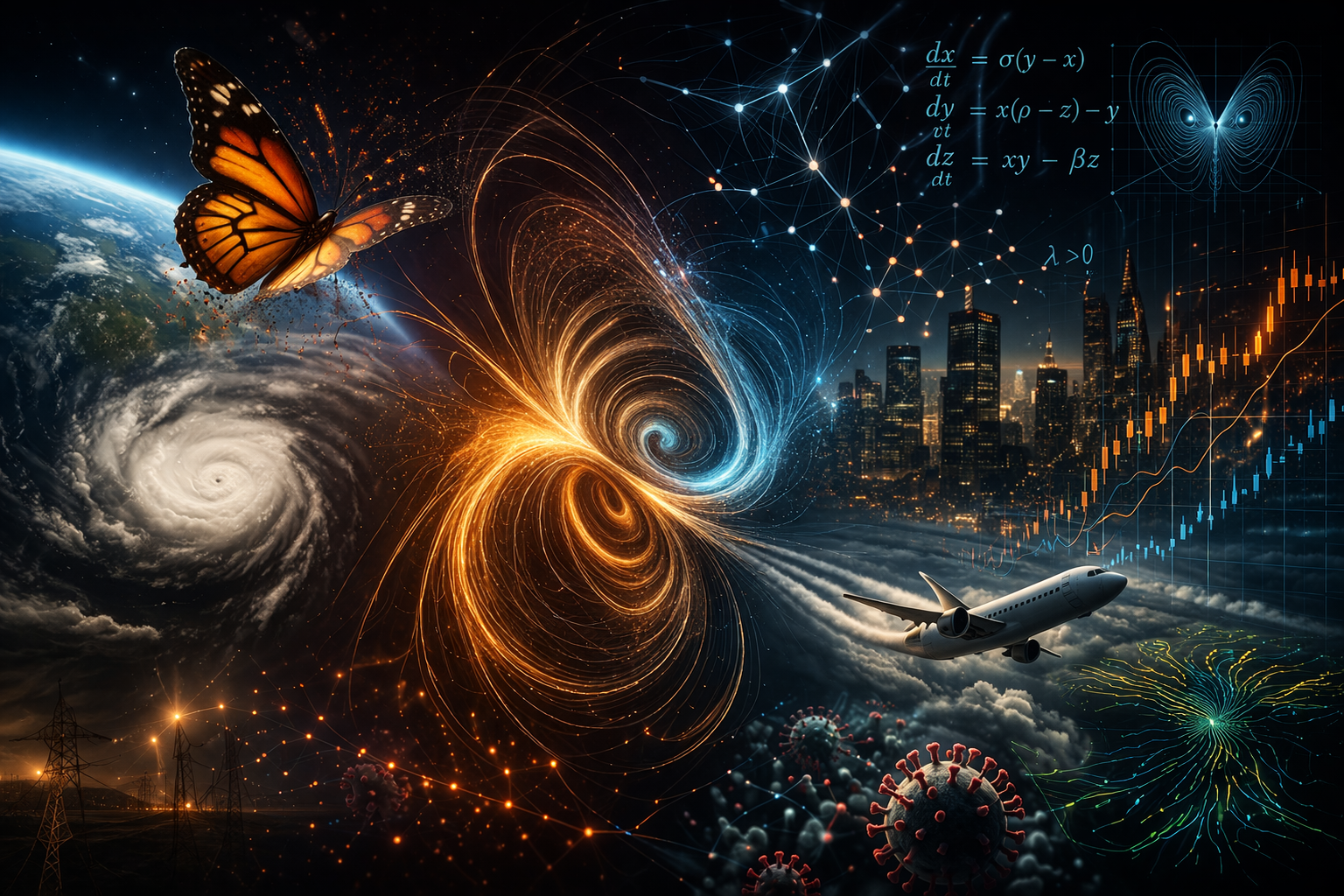
Butterfly wings in Brazil causing tornadoes in Texas.
Weather impossible to forecast beyond two weeks.
Systems too complex for equations.
That was yesterday’s story.
Today, chaos theory doesn’t just explain unpredictability.
It predicts it.
Engineers, meteorologists, economists, epidemiologists, and power-grid operators use chaotic models every day to forecast:
- Turbulence
- Weather patterns
- Market crashes
- Disease waves
Chaos theory went from academic curiosity to industrial backbone.
Chaos did not disappear.
We learned how to work with it.
The Breakthrough That Changed Everything
In the 1970s, chaos was discovered.
Not invented.
Discovered.
Edward Lorenz showed that tiny changes explode into massive differences.
He rounded a number:
0.506127 → 0.506
After a month, the paths diverged wildly.
Lyapunov time:
- Days for weather
- Hours for turbulence
This was the shock.
Deterministic system.
Unpredictable outcome.
Chaos is deterministic unpredictability.
The key realization:
Chaotic systems still have structure.
- Strange attractors
- Fractal geometry
- Scaling laws
Benoit Mandelbrot showed that financial markets are fractal.
H ≠ 0.5
Chaos is not randomness.
It is hidden structure that amplifies uncertainty.
From Theory to Prediction
1. Lyapunov Exponents & Predictability Horizons
Lyapunov exponents quantify sensitive dependence:
λ > 0 → chaotic (divergence e^λt)
λ = 0 → neutral
λ < 0 → stable
Weather: λ ≈ 1/day → ~10-day horizon
Turbulence: λ ≈ 100/s → milliseconds
ECMWF (2026): Ensemble forecasting (≈50 members) captures uncertainty.
We stopped predicting one future.
We started predicting many possible futures.
2. Phase Space Reconstruction
Takens’ theorem (1981):
You can reconstruct the attractor from a single time series.
τ = 1 / f_s
m = 2D + 1
Applications:
- Turbulence
- ECG signals
- Stock markets
Even incomplete data contains hidden geometry.
3. Shadow Manifolds & Model Error
Chaos says perfect tracking is impossible.
But we can follow a shadow manifold.
NASA (2026): 4D-VAR + chaotic error growth.
We don’t follow reality perfectly.
We stay close enough to remain useful.
Real-World Applications (2026)
Weather Forecasting
ECMWF IFS:
- 9 km global resolution
- 1.5 km convection scale
- 51 ensemble members
AI hybrids: GraphCast + physics → ~95% skill at 10 days.
Reality: 14-day probabilistic forecasts are now routine.
Turbulence & Aviation
NASA Langley: Chaos-based LES models.
- Drag prediction: ±2%
- Forecast window: ~60 seconds
- Accuracy: ~82%
Milliseconds of chaos…
turned into minutes of safety.
Financial Markets
| H value | Market type | Strategy |
|---|---|---|
| < 0.5 | Mean-reverting | Pairs trading |
| = 0.5 | Random walk | Buy & hold |
| > 0.5 | Trending | Momentum |
Markets are not noise.
They are structured unpredictability.
Epidemiology
SIR models + chaos corrections improve predictions.
Wave timing accuracy: ±3 days.
Power Grids
dθ_i/dt = ω_i + K/N Σ sin(θ_j − θ_i)
Chaos + ML predicts blackout risk up to 72 hours ahead.
Chaos is no longer failure.
It is a design parameter.
The Mathematics Behind It
Distance growth:
d(t) = d₀ e^{λt}
Doubling time:
τ_d = ln(2) / λ
Error in weather doubles every ~2.3 days.
This defines reality’s horizon.
Not what we can compute.
But what can be known.
AI Meets Chaos
- GraphCast → ultra-fast forecasts
- FourCastNet → global dynamics
- Neural operators → learn attractors
DeepMind: Chaos-informed AI is a new paradigm.
AI did not replace physics.
It learned its structure.
The New Forecasting Paradigm
- Week 1: ~99% accuracy
- Week 2: probabilistic
- Week 3+: climatology
This is not failure.
This is evolution.
Prediction did not collapse.
It transformed.
The Final Realization
Chaos theory revealed limits.
Then it taught us how to work within them.
Perfect prediction is impossible.
Useful prediction is everywhere.
We don’t control chaos.
We surf it.
Reality’s complexity became our greatest tool.
Prediction is no longer about certainty.
It is about navigating possibility.
TL;DR
- Chaos is deterministic unpredictability, not randomness.
- Weather forecasts now reach ~14 days probabilistically.
- Turbulence models achieve ~80% real-time accuracy.
- Markets show fractal structure (Hurst exponent).
- Power grids use chaos + ML for blackout prediction.
- AI + chaos = new forecasting paradigm.
References
- Lorenz, E. N. (1963). Deterministic nonperiodic flow.
- Mandelbrot, B. B. (1982). The Fractal Geometry of Nature.
- Takens, F. (1981). Detecting strange attractors.
- ECMWF (2026). IFS ensemble forecasting.
- NASA (2025). Large Eddy Simulation for turbulence.
- DeepMind (2023). GraphCast.