Symmetry Breaking: Why Reality Exists at All
A perfectly symmetric universe would contain no structure,
no change,
no observers.
At the beginning of the universe, physics suggests extreme symmetry.
No preferred directions.
Unified forces.
Identical regions.
This sounds perfect.
But it has a fatal flaw.
Without differences… nothing can happen.
- No gradients
- No contrast
- No processes
Perfect symmetry is indistinguishable from nothing.
Perfection, in physics, is sterile.
A universe without imperfections…
is a universe without events.
What Symmetry Means in Physics
Symmetry = invariance under transformation.
| Symmetry | Transformation | Conservation Law |
|---|---|---|
| Time translation | t → t + δt | Energy |
| Space translation | x → x + δx | Momentum |
| Rotation | θ → θ + δθ | Angular momentum |
| Gauge (QED) | ψ → eiαψ | Charge |
Noether’s theorem (1918):
Every continuous symmetry implies a conserved quantity.
Symmetry is not beauty.
It is constraint.
It defines what cannot change.
Early universe (~10⁻³⁶ s):
Possible unified symmetry (GUT scale).
But:
Perfect symmetry → no evolution.
The Symmetry-Breaking Cascade
As the universe cooled, symmetry broke in stages.
Each break created new physics.
Each break created reality.
1. GUT Phase Transition
SU(5) → SU(3)C × SU(2)L × U(1)Y
- Strong force separates
- Electroweak remains unified
This is the first fracture of unity.
One force becomes many.
2. Electroweak Phase Transition
SU(2)L × U(1)Y → U(1)EM
The Higgs field acquires a vacuum expectation value:
⟨φ⟩ = 246 GeV
- W and Z gain mass
- Photon remains massless
Mass appears not as a property…
but as a consequence of broken symmetry.
3. QCD Phase Transition
Quark–gluon plasma → hadrons
Chiral symmetry breaks.
New structure emerges:
- Protons
- Neutrons
- Atomic matter
Reality builds layer by layer…
each time symmetry fails.
The Higgs Mechanism
Higgs potential:
V(φ) = −μ²|φ|² + λ|φ|⁴
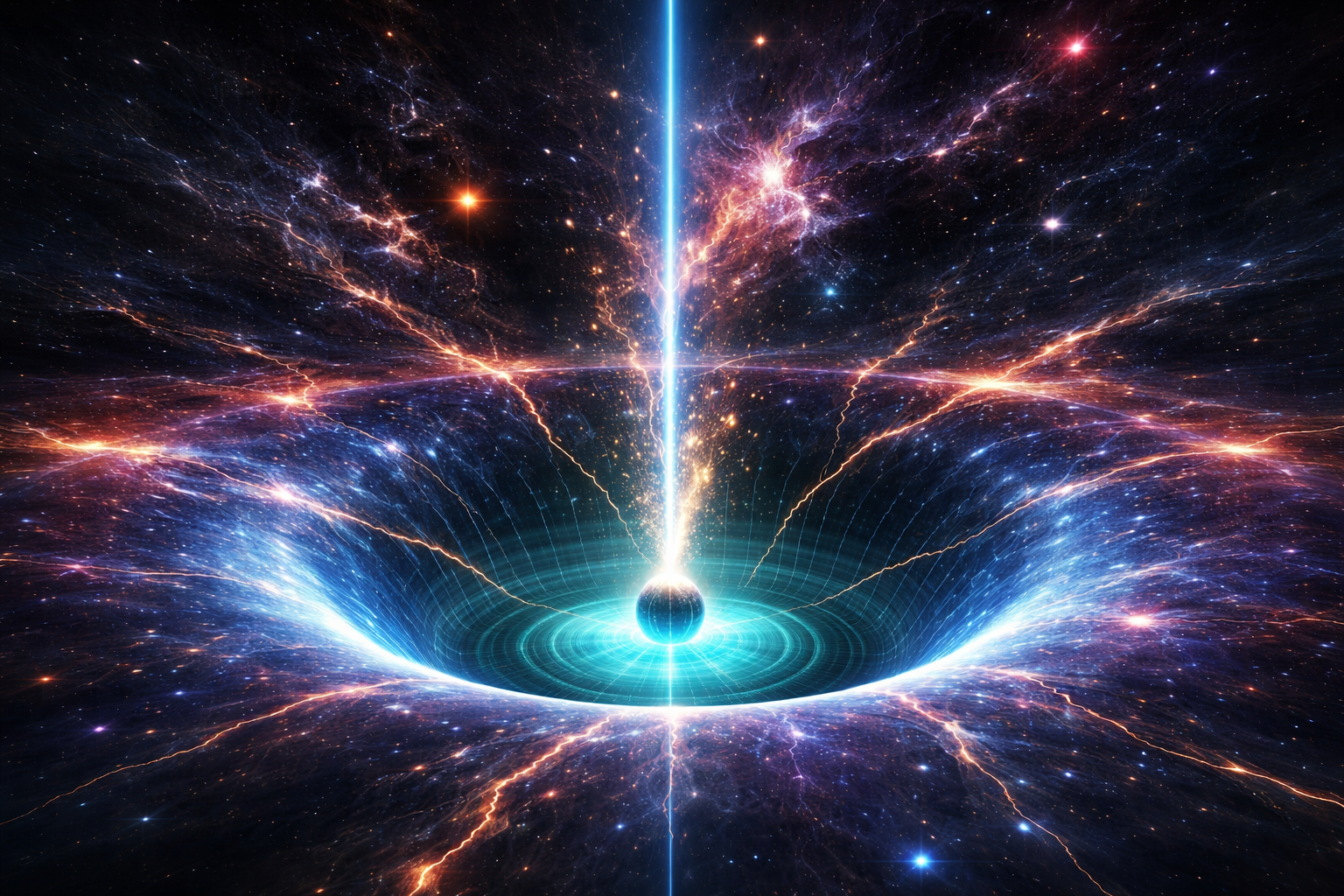
Shape: “Mexican hat”.
System chooses one minimum → symmetry breaks.
Result:
- Gauge bosons gain mass
- Fermions gain mass
mW = (g v)/2
mZ = (√(g²+g'²) v)/2
mf = yf v/√2
LHC (2012): Higgs boson confirmed.
Modern data continues refining its properties.
Mass is not fundamental.
It is emergent.
Why Imperfection Creates Reality
Perfect symmetry → maximum uniformity → minimum information.
Information theory:
H = −Σ p_i log p_i
Uniform distribution → no usable structure.
But the early universe had tiny fluctuations:
ΔT/T ≈ 10⁻⁵
These seeded:
- Galaxies
- Stars
- Planets
- Life
We are built from imperfections.
Matter vs Antimatter
Symmetry breaking also explains why matter exists at all.
Sakharov conditions:
- Baryon number violation
- CP violation
- Non-equilibrium processes
Without these…
matter and antimatter would annihilate completely.
Instead:
We exist.
The Mathematical Core
Spontaneous symmetry breaking:
Laws are symmetric.
The vacuum is not.
Multiple equivalent minima → system chooses one.
That choice defines reality.
Goldstone bosons emerge.
Gauge fields absorb them → mass appears.
Experimental Timeline
| Year | Discovery | Impact |
|---|---|---|
| 1964 | Higgs mechanism | Mass generation theory |
| 1983 | W/Z bosons | Electroweak confirmation |
| 2012 | Higgs boson | LHC validation |
| 2026 | Precision measurements | Refining early-universe physics |
Philosophical Implications
Symmetry breaking is the universe choosing one reality among many.
Why this outcome?
- Chance?
- Multiverse?
- Anthropic selection?
This is where physics meets philosophy.
The Final Paradox
Perfect symmetry = eternal stasis.
Broken symmetry = dynamic reality.
The universe became real the moment it chose imbalance.
We exist because perfection failed.
Reality is asymmetry’s triumph.
And the deepest insight is this:
The universe did not become complex despite imperfection.
It became complex because of it.
TL;DR
- Perfect symmetry means no structure or change.
- Symmetry breaking creates forces, mass, and matter.
- The Higgs mechanism gives particles mass.
- Tiny early-universe fluctuations created all structure.
- Reality exists because symmetry failed.
References
- Higgs, P. W. (1964). Spontaneous symmetry breaking.
- Weinberg, S. (1967). Electroweak model.
- ATLAS (2026). Higgs and vector boson scattering.
- Kibble, T. W. B. (1976). Cosmic defects.
- Sakharov, A. D. (1967). Matter asymmetry.
- Planck Collaboration (2018). CMB fluctuations.