Black Holes Might Not Destroy Information After All
What if the information paradox was never a paradox?
What if the greatest crisis in physics…
was never a crisis at all?
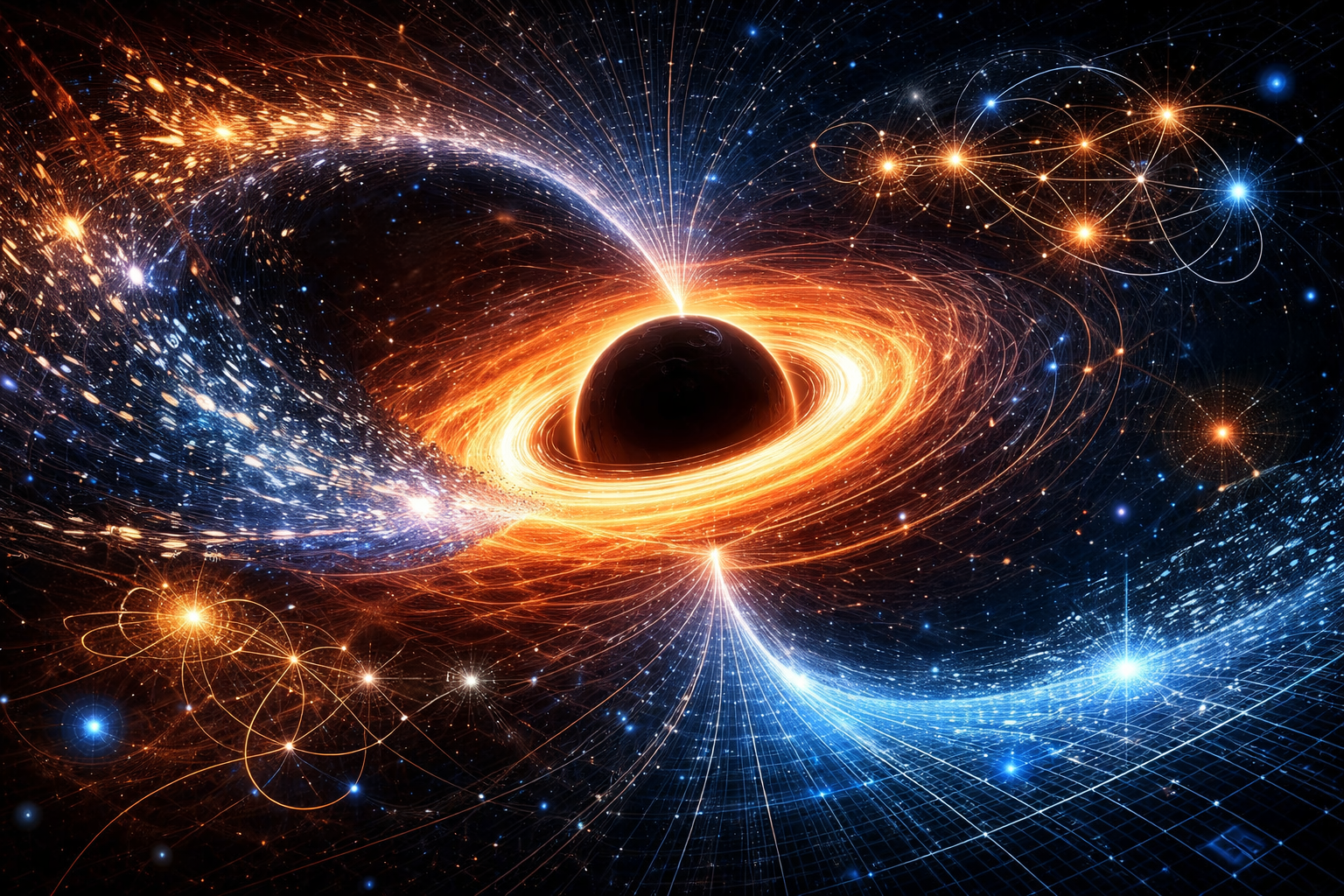
Black holes don’t just bend space and time.
They hijack them.
And with them, they drag our most basic assumptions about reality into a corner:
What if reality itself isn’t as stable as we think?
The Beginning of the Problem
In 1974, Stephen Hawking calculated that black holes radiate.
They glow.
They shrink.
They evaporate.
On the surface, it was one of the most beautiful results in theoretical physics.
A black hole is not just a cosmic trash can.
It is a thermodynamic object — with temperature, entropy, and fate.
But beneath that beauty lived a hidden cost.
Hawking radiation looks thermal.
Random.
Featureless.
Stripped of structure.
And if a black hole completely disappears…
what happens to everything that fell inside?
At first, the answer seemed brutal.
It’s gone.
Forever.
That sounded like a simple boundary condition.
But it was, in fact, a threat to the foundations of physics.
The Paradox That Shouldn’t Exist
Quantum mechanics rests on one simple, unforgiving rule:
Information is never destroyed.
Every state evolves in a perfectly reversible way.
The universe “remembers” its past.
It does not overwrite it.
But Hawking’s calculation said the opposite.
Black holes evaporate into pure thermal radiation.
No memory.
No trace.
No history.
A fundamental contradiction.
Physics had backed itself into a corner.
- Quantum mechanics is incomplete,
- Or spacetime behaves in impossible ways,
- Or something deeper is missing.
None of these felt acceptable.
So the paradox stayed.
Unresolved.
Uncomfortable.
Waiting.
The First Crack: Holography
Then came a strange idea.
What if reality doesn’t live in volume?
What if it lives on boundaries?
In 1997, Juan Maldacena proposed AdS/CFT.
A duality where gravity in a higher-dimensional space is equivalent to a quantum field theory on its boundary.
And here is the key:
The boundary theory is perfectly unitary.
Which means: information cannot be lost.
This was the first real hint.
Not a full solution — but a direction.
Maybe the problem was never black holes.
Maybe it was how we think about space itself.
Reality might not be a 3D movie.
It might be a hologram, projected from a 2D surface.
The Page Curve: Where Everything Changes
For decades, Hawking’s prediction implied that entropy only grows.
But Don Page proposed something different.
If black holes obey quantum mechanics, entropy should:
- Rise…
- And then fall.
This is the Page curve.
A signature of information returning.
In 2019, something remarkable happened.
Using quantum extremal surfaces, physicists reproduced that exact curve.
But only after adding something unexpected:
Islands.
Regions inside the black hole that somehow count as part of the radiation.
This sounds absurd.
It should be impossible.
And yet…
The math works. Perfectly.
Information was never lost.
We were just looking in the wrong place.
Replica Wormholes: The Universe Rewrites Itself
Then things got even stranger.
To calculate entropy correctly, gravity did not behave the way we expected.
Different copies of spacetime — “replicas” — became connected.
Through wormholes.
Not sci-fi shortcuts.
But mathematical structures that encode correlations.
The universe was stitching information together behind the scenes.
What looked random…
was never random at all.
The radiation from a black hole stopped looking like noise.
It started looking like data compressed in geometry.
From Theory to Reality
This is not just abstract math anymore.
The SYK model shows the Page curve directly.
We can simulate aspects of quantum gravity.
Not metaphorically.
Literally.
At the same time, observations are starting to push boundaries:
- Supermassive black holes appearing too early in the universe,
- Possible gravitational wave echoes,
- Hints that horizons may not be empty.
The line between theory and experiment is getting thinner.
A Different Picture of Reality
So what is the resolution?
It is not a single equation.
It is a shift in perspective.
Information is preserved.
But not in the way we expected.
It is encoded non-locally.
Spread across correlations.
Hidden in geometry.
Reality is not made of things.
It is made of relationships.
The black hole is no longer a vault.
It is a code.
A highly compressed, holographic, almost unreadable — but still readable state.
The Deeper Implication
If black holes do not destroy information…
Then the universe is fundamentally consistent.
Nothing is ever truly lost.
But it also means something else.
What we perceive is not the full structure of reality.
We see outcomes.
We do not see the encoding behind them.
And sometimes…
we mistake hidden order for randomness.
The universe looks noisy because we read it with the wrong codebook.
Not because the codebook is gone.
The Final Twist
The paradox was never just about black holes.
It was about our assumptions.
About space.
About information.
About reality.
And in the end, black holes did not break physics.
They exposed its deeper layer.
Hawking radiation is not just noise.
It is structure.
Encoded.
Subtle.
Almost invisible.
But real.
What looked like destruction…
was actually information, hiding in plain sight.
TL;DR
- Black holes evaporate via Hawking radiation.
- This led to the information paradox.
- Quantum mechanics says information cannot be destroyed.
- The Page curve shows entropy rises, then falls.
- Modern results suggest information is preserved.
- Reality may be holographic and non-local.
References
- Hawking, S. W. (1975). “Particle creation by black holes”. Communications in Mathematical Physics.
- Penington, G. (2019). “Entanglement Wedge Reconstruction and the Information Paradox”. arXiv:1905.08255.
- Almheiri, A. et al. (2019). “Entropy of bulk quantum fields”. arXiv:1905.08762.
- Ryu, S., Takayanagi, T. (2006). “Holographic entanglement entropy”. Physical Review Letters.
- Maldacena, J. (1998). “Large-N limit and supergravity”.