 NERDICATE
What Is ADHD, Really? Understanding the Science Behind the Diagnosis
ADHD is often reduced to distraction, hyperactivity, or a lack of focus. But what is actually happening in the brain? Explore the neuroscience behind attention, motivation, dopamine, and executive function to discover what science really knows about ADHD, what popular explanations get wrong, and which questions researchers have yet to answer.
What Is ADHD, Really? Understanding the Science Behind the Diagnosis
ADHD is often described as “having trouble concentrating.” That description is not wrong, but it is radically incomplete. Attention-deficit/hyperactivity disorder is a neurodevelopmental condition involving persistent patterns of inattention, hyperactivity, and impulsivity that interfere with everyday functioning.
The more accurate question is not “why can’t people with ADHD focus?” but “why is their attention, motivation, and behavioural control uneven across situations?” The answer is neither a moral failure nor a simple dopamine deficiency. It lies in a complex interaction of genetics, brain development, environment, and the demands of a particular task.
More than distraction
ADHD is defined by persistent difficulties in one or both of two broad domains:
- Inattention: difficulty sustaining attention, organising tasks, following instructions, remembering details, or completing work.
- Hyperactivity and impulsivity: restlessness, excessive movement or talking, interrupting, impatience, and difficulty waiting or restraining immediate responses.
Crucially, these are not occasional behaviours. Everyone becomes distracted, forgetful, restless, or impulsive sometimes. A diagnosis depends on a persistent pattern that is inappropriate for a person’s developmental stage, begins early in life, appears in multiple settings, and causes meaningful impairment.
That last condition matters. Being unable to concentrate during a boring meeting is not, by itself, ADHD. Struggling consistently to regulate attention and impulses across school or work, home, and social life — with real consequences for functioning — is closer to what the diagnosis describes.
What diagnosis actually requires
Under DSM-5-based criteria, a clinician looks for several symptoms of inattention and/or hyperactivity-impulsivity that have persisted for at least six months. Children under 17 generally require at least six symptoms in a domain; people aged 17 or older require at least five.
Several further requirements are essential:
- Some symptoms must have been present before age 12.
- Symptoms must occur in two or more settings, such as home and school or work.
- They must impair social, academic, or occupational functioning.
- Other explanations — such as anxiety, depression, sleep problems, trauma, learning difficulties, or substance use — must be considered.
ADHD is therefore not diagnosed from a short online quiz. A responsible assessment considers developmental history, current functioning, collateral information where appropriate, and alternative explanations for similar symptoms.
The three presentations
ADHD is heterogeneous: people with the same diagnosis can have very different daily experiences.
| Presentation | Dominant difficulty | Often overlooked because |
|---|---|---|
| Predominantly inattentive | Organisation, sustained attention, working memory, task completion | The person may be quiet, daydreamy, or internally distracted rather than visibly disruptive |
| Predominantly hyperactive-impulsive | Restlessness, waiting, impulse control | It is more visible in childhood but may become less obvious with age |
| Combined | Substantial features of both domains | Symptoms may be attributed to personality, laziness, or poor discipline |
The inattentive presentation is particularly easy to miss. A child who stares out of a window rather than climbing on furniture may not attract the same attention as a visibly hyperactive classmate, yet still face serious difficulties with planning, memory, and follow-through.
The dopamine story is incomplete
ADHD is frequently reduced to a slogan: “people with ADHD have low dopamine.” The reality is more interesting — and less tidy.
Dopamine is involved in reward prediction, motivation, reinforcement learning, and behavioural control. Because stimulant medications used for ADHD affect catecholamine signalling, including dopamine and noradrenaline systems, dopamine has understandably become central to public explanations of the condition.
But evidence does not support the simple claim that ADHD is universally caused by a “hypo-dopaminergic state.” Dopamine signalling is likely involved in ADHD, while evidence for low dopamine per se as the key mechanism is limited.
A more defensible view is that ADHD involves differences in how the brain regulates attention, motivation, and inhibition. Some models emphasise altered reward processing: delayed rewards may feel less motivating, making long-term goals harder to sustain even when the person genuinely wants to achieve them.
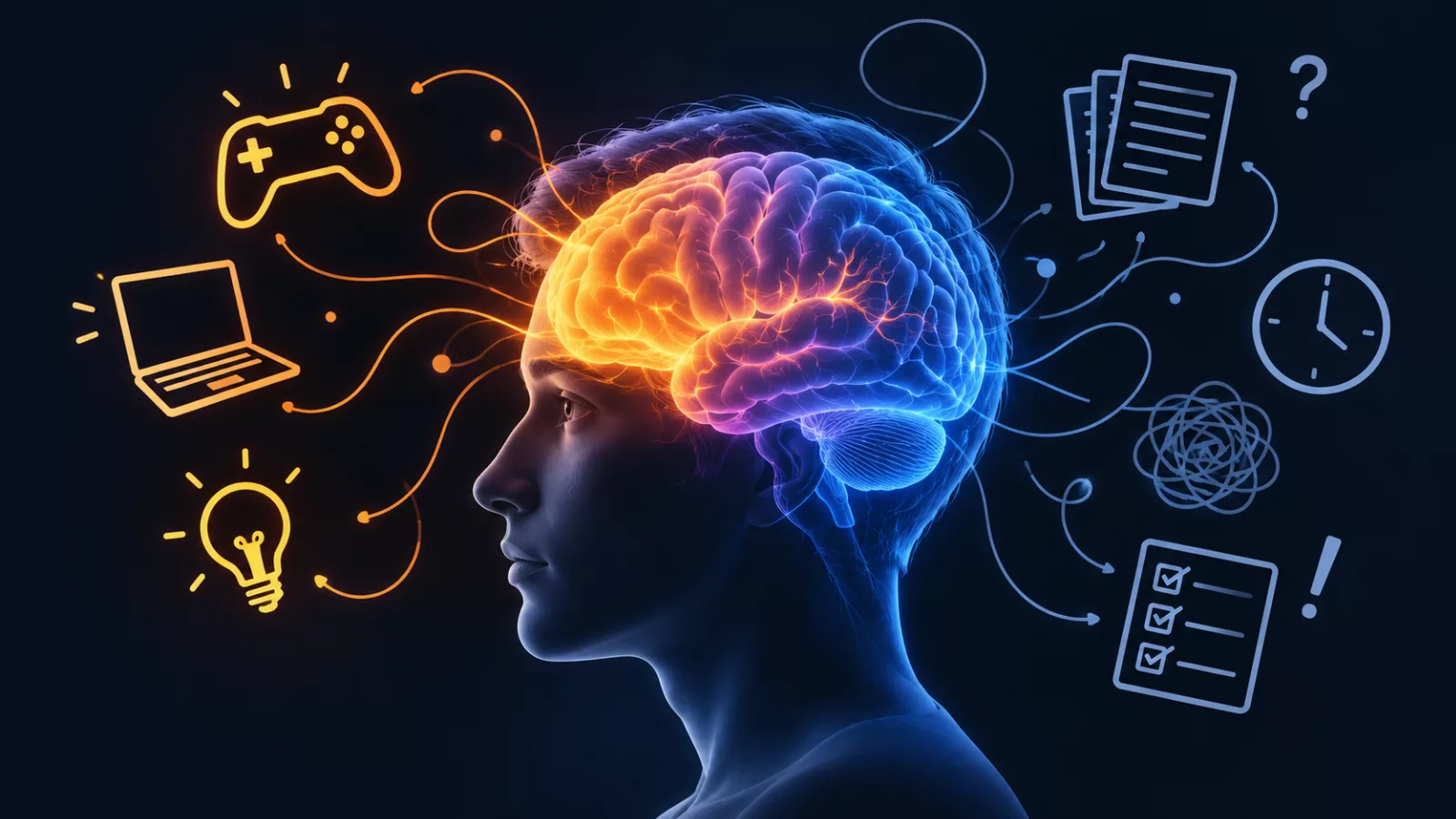
That helps explain a familiar paradox: someone with ADHD may struggle to begin a routine task, yet become deeply absorbed in something intrinsically interesting. This is not proof that they “can focus when they want to.” It suggests that attention and motivation are regulated by context, interest, urgency, and reward structure — not by a simple on/off switch.
Genes, environment, and development
ADHD runs in families, and genetic factors appear to play a substantial role. A person diagnosed with ADHD is more likely to have a close biological relative with similar symptoms, although the exact causes remain uncertain and probably involve a combination of influences.
Research investigates several contributors:
- Genetic variation and family history.
- Brain structure and activity.
- Prenatal and early-life exposures.
- Hormones and other biological molecules.
- Social and environmental conditions.
None of these factors alone “causes ADHD” in a simple, deterministic sense. The useful model is probabilistic: inherited and developmental differences shape vulnerability, while environments can amplify or reduce impairment.
This also explains why ADHD can look different across life stages. A child’s hyperactivity may become adult restlessness, poor time management, impulsive decision-making, or difficulty managing administrative demands. The underlying regulatory difficulty may persist even when its outward form changes.
Why “just try harder” fails
ADHD is not a shortage of effort. Many people with ADHD expend enormous effort compensating for difficulties with planning, initiation, memory, and impulse control.
The problem can be understood as a mismatch between the brain’s regulatory style and environments designed around sustained, delayed, self-directed work. A task that is vague, distant in time, low in immediate reward, and high in organisational demand can be disproportionately difficult — even when the person values the outcome.
This is why practical support often focuses on changing the structure of the task rather than merely increasing willpower:
- Break work into smaller, concrete steps.
- Use external reminders, timers, and visual schedules.
- Reduce competing distractions.
- Create immediate feedback or short-term rewards.
- Use body doubling, accountability, or structured routines.
- Match demanding work to periods of higher energy and interest.
These strategies do not cure ADHD. They reduce the cognitive load of initiation, organisation, and sustained attention.
Treatment is not one-size-fits-all
There is no cure for ADHD, but evidence-based treatments can reduce symptoms and improve functioning.
Standard approaches include:
- Medication: stimulant and non-stimulant medicines approved to reduce ADHD symptoms and improve functioning.
- Psychosocial interventions: cognitive behavioural therapy, parent training, and school-based support.
- Skills and environmental adjustments: routines, planning systems, workplace accommodations, and educational strategies.
- Combination approaches: treatment is often individualised, combining more than one form of support.
Medication can be highly helpful for many people, but it is not a character judgement, a shortcut, or a universal requirement. The appropriate approach depends on symptoms, impairment, co-occurring conditions, preferences, medical history, and access to qualified care.
What ADHD is not
Several popular ideas make the science harder to understand.
- ADHD is not simply “being distracted.” It involves persistent regulation difficulties across attention, activity, and impulse control.
- ADHD is not caused by bad parenting. Genetics and neurodevelopmental factors are central, though environment can influence impairment and support.
- ADHD is not a lack of intelligence. It affects regulation and execution, not intellectual worth.
- ADHD is not always visible. Inattentive symptoms can be internal, quiet, and easily misread as daydreaming or disinterest.
- ADHD is not a modern invention. Its diagnostic framework has evolved, but the condition describes long-recognised patterns of impairment, not a social-media trend.
The useful way to think about it
ADHD is best understood not as an absence of attention, but as uneven regulation of attention, motivation, and action. Someone may have difficulty directing attention where society expects it, while being fully capable of intense focus under different conditions.
That does not make the condition trivial. The gap between ability and consistent execution can affect education, employment, relationships, finances, and mental health. But it does explain why simplistic labels — lazy, careless, unmotivated, chaotic — fail both scientifically and humanly.
The science points toward a more useful framing: ADHD is a developmental difference in self-regulation, shaped by biology and context, with real consequences that can often be reduced through informed support.
Stay curious. Think critically. Question everything — including easy explanations.