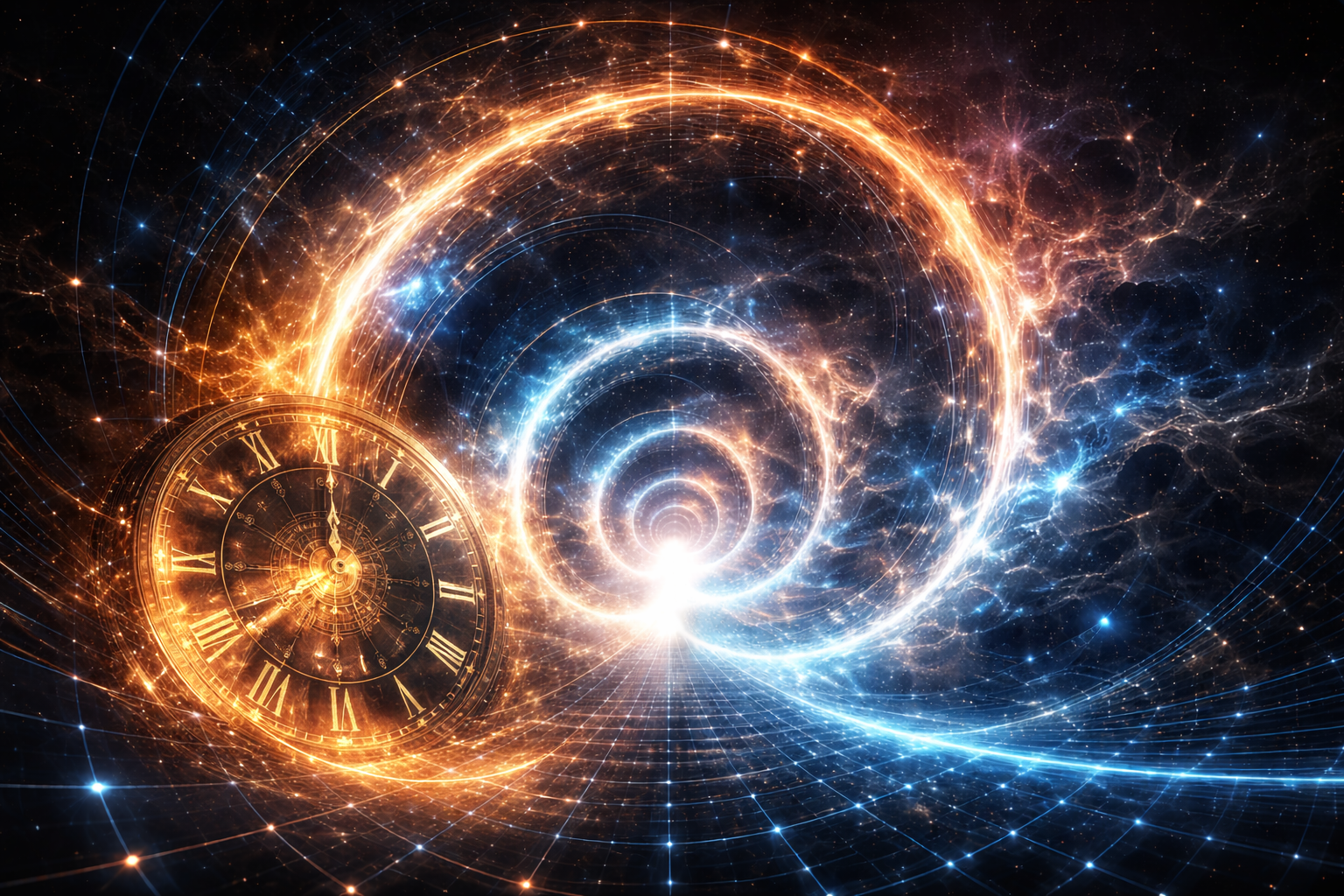
What If Time Is a Processing Loop?
The universe might not be flowing through time. It might be computing it.
What if time isn’t a river…
but a loop of processing?
Not a fundamental dimension.
Not a backdrop.
A computational thread
in a universe that doesn’t actually “move,” it recalculates.
This isn’t science fiction.
It’s a convergence of:
- quantum mechanics,
- general relativity,
- computation theory,
- and cosmology.
And the more we look at them, the stranger time looks.
Because the flow of time we experience might not be built into reality.
It might be emergent, like temperature from atoms.
And that opens a disturbing possibility:
Time is a loop, not a line.
The Illusion of Linear Time
We experience time as:
- Linear,
- Forward,
- Unidirectional.
Past fixed.
Future open.
Now flowing.
But physics gives us no fundamental law that says:
“Time must go this way.”
Relativity and quantum mechanics are time-symmetric.
Only thermodynamics has a clear arrow:
Entropy increases → time flows forward.
So the arrow of time is not a rule of the universe.
It is a statistical fact.
Reality computes in two directions.
Our perception only lines up with one.
That hints at something deeper.
What if time is not something the universe has…
but something it does?
Process-Oriented Physics: From “What Is” to “What Happens”
Modern physics is slowly moving from:
“What exists?”
to
“What happens?”
In this view:
- Space is a network of relations.
- Matter is excitations of fields.
- Time is the ordering of those events.
There is no “stage.”
There is only play.
Relational interpretations (like some quantum and relational views)
say:
Time is defined by correlations.
A clock ticks.
Another system changes.
They correlate.
Before that correlation exists, there is no “before.”
So time is not prior to events.
It is built from them.
That turns time from a background into a process.
And processes can loop.
Quantum Mechanics and the “Now” Illusion
Quantum mechanics is notorious for blurring the line between past and future.
In the two-slit experiment,
the path a particle takes depends on what happens later at the screen.
Delayed-choice experiments show the same:
Decision in the future changes how things appeared in the past.
In such setups, time ordering becomes flexible.
If you take this seriously,
you are forced to admit:
Our firm sense of “now” is not mirrored in the formalism.
The wave function evolves.
Measurements branch.
Correlations grow.
But there is no explicit “current time slice”
etched into the equations.
That suggests:
The flow of time is a feature of our perspective,
not of the universe’s deep structure.
Spacetime as a Computation
The leap comes when you combine:
General relativity (spacetime as geometry),
with
Quantum information (states as information).
In some approaches, spacetime is emergent from quantum computation.
- Entanglement creates connectivity.
- Tensor networks mimic geometry.
- Holographic AdS/CFT suggests that gravity is encoded in a lower-dimensional quantum system.
In that picture, time evolution is like updating a quantum circuit.
Each step applies a gate.
The system reevaluates its state.
So the universe may not be flying through time.
It may be re-running a calculation.
Each “moment” is a state in a larger process loop.
This is where the idea of time as a processing loop becomes physically plausible.
Cyclic Cosmology and the “Big Bang Afterthought”
Cyclic and conformal cyclic cosmology (Penrose) models
offer a macroscopic version of the loop.
In Penrose’s view:
- The universe expands forever.
- Matter decays.
- Photons dominate.
- Geometry becomes conformally symmetric.
He argues that this infinite future can be mapped to the hot dense past of a new universe.
Each Big Bang is both an end and a beginning.
Viewed this way, time loops cosmologically, not just psychologically.
The question “What happened before the Big Bang?”
gets answered:
“It was the far future of a previous cycle.”
That is a literal loop of time,
extended to the entire universe.
Eternal Inflation and the Multiverse Loop
In eternal inflation,
space inflates forever in some regions,
while others exit inflation and form “bubble universes.”
From the perspective of an observer inside a bubble,
there is a beginning (hot dense phase).
From the perspective of inflation,
there is no beginning.
Time stretches infinitely backward.
In some interpretations,
these inflationary histories can be retraced,
and certain configurations recur.
So time, in the larger multiverse,
may look approximately recurrent.
Not a perfect loop.
But a statistical echo.
This suggests that time’s structure might be closer to a complex dynamical system
than a straight line.
Time Crystals and Physical Processing Loops
The connection becomes even sharper in a recent discovery:
time crystals.
Time crystals are systems where
particles oscillate in a periodic pattern
without energy loss,
even at equilibrium.
The system returns to the same state,
not in space,
but in time.
The oscillation is self-sustained.
It doesn’t fade.
This is the first physical realization of a time loop:
a state that repeats in time,
while the rest of the universe moves forward.
If such structures can exist even in small quantum systems,
why not in the universe’s larger structure?
The idea isn’t that the universe “goes back.”
It’s that some parts of it recompute cyclically.
The Simulation‐Loop Hypothesis
A more speculative but evocative idea:
What if the universe is computing itself?
The Big Bang is the initial state.
Every physical process is a step.
Every interaction is a computation.
But unlike a classical computer,
this “universe computer” has causal closure.
It doesn’t write to an external tape.
It updates its own state.
So the universe might be:
not progressing,
but re-running
over and over,
each time following the same consistent rules.
In this view,
time is the loop of the universe’s own updating process.
From outside, the universe might look static:
an abstract structure.
From inside, it looks like flow,
because the loop unfolds new events each cycle.
Time as a Loop in Quantum Gravity
In several quantum gravity approaches,
time becomes even less fundamental:
- Loop quantum gravity:
Time is replaced by relational evolution between spin network nodes. - Causal sets:
Fundamental entities are events with causal relations.
Time is the partial order of events. - AdS/CFT holography:
Gravity in the bulk emerges from a unitary quantum system without explicit time.
In all these, the flow of time is derived,
not primary.
This is exactly what you’d expect
if time were a processing loop that generates the appearance of flow.
The universe doesn’t move in time.
Time emerges as a property of how it computes itself.
The Mind–Time Loop
The loop idea also fits strangely well
with what we know about consciousness and memory.
We don’t experience time as an external clock.
We experience it through change:
- Neurons firing.
- Memories forming.
- Decisions happening.
Our brain is a recurrent network.
It loops over information.
It updates its state.
So our sense of time is a subjective loop
running on top of the universe’s larger loop.
When physicists say “Now doesn’t exist in the equations,”
they forget that now is where observers live.
So the universe computes in time-loops.
Brains implement nested loops.
And the illusion of a moving present is the joint product.
The Deep Shift: From River to Recalculation
The deepest shift is this:
We used to think:
“Time is a river, and we float on it.”
Now we might have to think:
“Time is a repetition of the universe updating its configuration.
We are in it, not on it.”
This changes the meaning of:
- Change,
- Memory,
- Identity,
- and the end of time.
If time is a loop,
then the end of the universe
might not be a final state,
but a return to a previous configuration,
or a restart of the computation.
This is not a proven picture.
It is a consistent possibility,
tying together computation, quantum gravity, and cosmology.
TL;DR
- The arrow of time is not a fundamental law, but a statistical arrow of entropy.
- Spacetime may emerge from quantum computation and networks of entanglement.
- Cyclic and conformal cyclic cosmologies suggest time can loop cosmologically.
- Time crystals provide physical evidence of systems that repeat in time.
- Quantum gravity frameworks (loop LQG, causal sets, AdS/CFT) treat time as derived, not primitive.
- A “universe as a self-computing loop” view is speculative but consistent: time is the processing loop of the universe updating itself.
- Our experience of time is a nested loop in our brains, overlapping with the universe’s computational loop.
References
- Penrose, R. (2010). Cycles of Time: An Extraordinary New View of the Universe.
- Vedral, V. (2010). Decoding Reality: The Universe as Quantum Information.
- Wilczek, F. (2012). Quantum Time Crystals.
- Rovelli, C. (1998). Relational Quantum Mechanics.
- Maldacena, J. (1998). The Large N Limit of Superconformal Field Theories and Supergravity (AdS/CFT).
- Planck Collaboration. (2018). Planck 2018 results. VI. Cosmological parameters.
- Susskind, L. (2017). The Theoretical Minimum: Quantum Mechanics and Cosmology.