We Detected Quantum Vacuum Effects in Real Experiments
Empty space is not empty.
And physics has already proven it.
In classical physics, vacuum meant:
- No particles
- No energy
- Nothing happening
Quantum physics tells a different story.
Every point in space contains quantum fields that never settle to zero.
They fluctuate constantly.
Particle–antiparticle pairs appear… and disappear.
These are not theoretical curiosities.
We measure them in real experiments.
Once you accept that vacuum is active…
space is no longer background.
It becomes part of reality itself.
What Is the Quantum Vacuum?
Quantum field theory shows that space is never truly empty.
Every fundamental interaction has a field filling all space:
- Electromagnetic field
- Electron field
- Quark fields
- Higgs field
Even in their lowest energy state, these fields fluctuate.
The reason lies in the Heisenberg uncertainty principle:
ΔE · Δt ≥ ℏ / 2
Energy can fluctuate briefly.
Particles can appear… then vanish.
This creates what we call the quantum vacuum.
Lowest energy does not mean zero activity.
It means irreducible activity.
The Casimir Effect: Force from Nothing
Predicted in 1948 by Hendrik Casimir.
Measured experimentally decades later.
Setup:
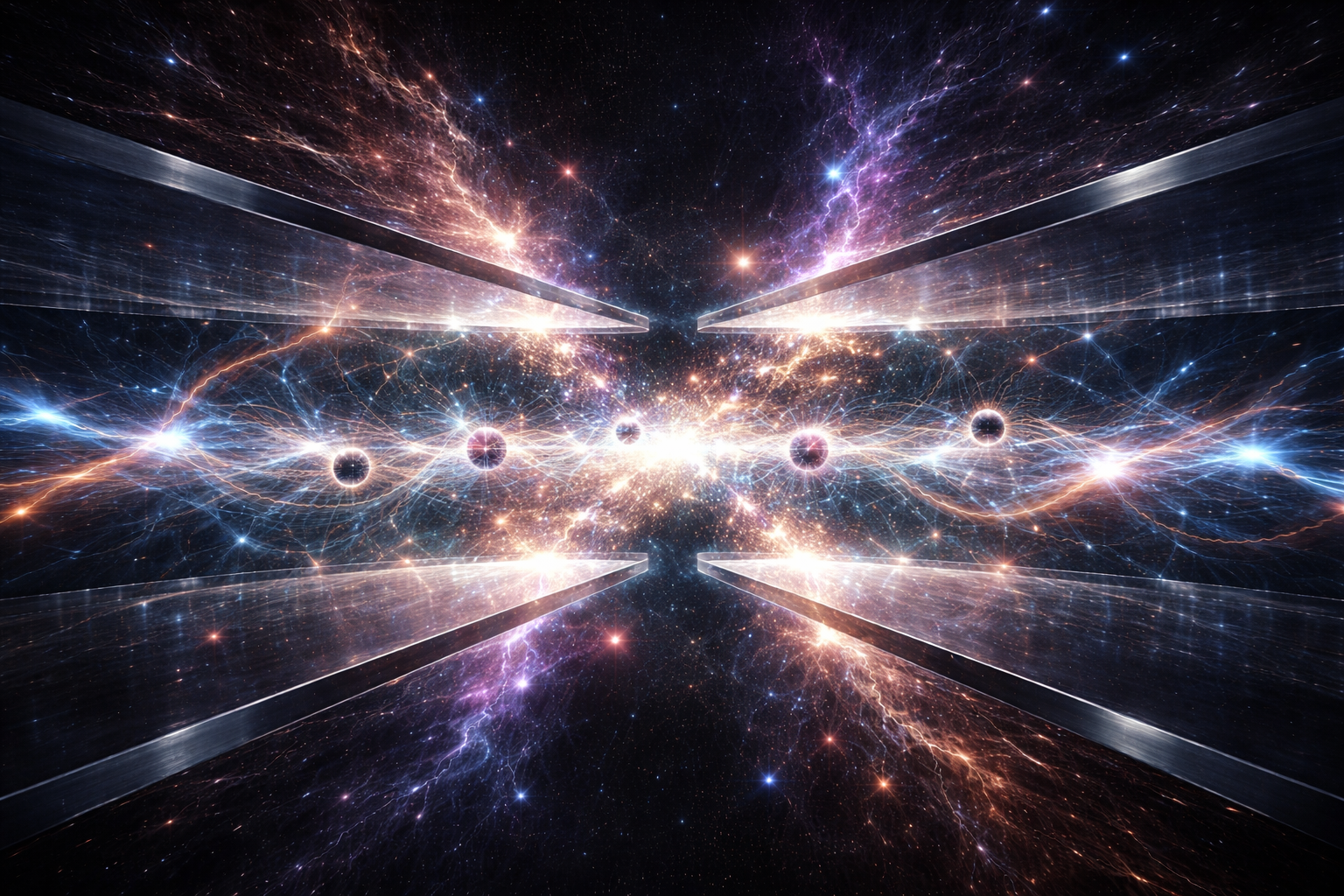
- Two uncharged metal plates
- Separated by ~100 nm
- Placed in vacuum
Classical physics predicts no force.
Quantum physics predicts attraction.
And experiments confirm it.
Why?
- Vacuum fluctuations have wavelengths
- Between plates → limited modes
- Outside → all modes allowed
Result:
Pressure imbalance pushes plates together.
F = −π² ℏ c A / (240 d⁴)
Modern precision:
- 1997: ±5%
- 1998: ±4%
- 2026: ~0.1%
This is no longer theory.
This is engineering-level physics.
The Lamb Shift: Vacuum Alters Atoms
According to early theory, two hydrogen energy levels should be identical.
Experiment (1947):
They are not.
Difference: ~1058 MHz.
This is the Lamb shift.
Cause:
Vacuum fluctuations interact with the electron.
Virtual photons slightly change its energy.
Modern measurements:
- Muonium experiments → extreme precision
- Agreement with quantum electrodynamics
Atoms are not isolated.
They constantly interact with empty space.
Spontaneous Emission: Vacuum Creates Light
Excited atoms emit photons spontaneously.
Classical view: random decay.
Quantum view:
Vacuum fluctuations trigger emission.
Confirmed in:
- Cavity QED experiments
- Superconducting circuits
- Controlled quantum systems (MIT, 2023)
Without vacuum fluctuations…
light emission would not exist.
Modern Experiments (2020–2026)
Nanoscale Casimir Engineering
Superconducting systems show measurable jumps in vacuum force.
We are beginning to control vacuum effects directly.
Quantum Vacuum Control
RF cavities allow manipulation of vacuum fluctuations.
We are moving from observation…
to engineering.
Cosmology Connection
Vacuum fluctuations seeded structure in the early universe.
Galaxies may originate from quantum noise.
Hawking Radiation
Near black holes, vacuum fluctuations create real particles.
Lab analogs confirm similar effects.
The vacuum is not universal.
It depends on context, motion, and gravity.
Why This Changes Everything
Quantum vacuum is not abstract.
It is measurable.
It is real.
And it drives fundamental processes:
- Atomic physics
- Forces between objects
- Cosmology
Measured vacuum energy density:
ρ_vac ≈ 10⁻⁹ J/m³
This is close to observed dark energy.
Which suggests something profound:
The same vacuum measured in labs…
may drive the expansion of the universe.
The Vacuum Energy Paradox
Quantum theory predicts vacuum energy that is:
10¹²⁰ times too large.
This is the worst mismatch in physics.
Not a small error.
A fundamental problem.
Vacuum in Everyday Reality
| Effect | Role of vacuum | Impact |
|---|---|---|
| Casimir effect | Force from fluctuations | Nanotechnology |
| Lamb shift | Energy correction | Atomic physics |
| Spontaneous emission | Photon generation | Lasers, LEDs |
| van der Waals | Molecular forces | Chemistry |
| Quantum tunneling | Barrier crossing | Nuclear physics |
No vacuum…
No modern technology.
We are not living in empty space.
We are living inside a quantum medium.
The Final Realization
We once thought space was empty.
Now we know it is filled with energy, fluctuations, and measurable effects.
Reality is not particles moving through void.
It is fields in constant motion.
We didn’t discover something inside space.
We discovered that space itself is something.
TL;DR
- Vacuum is not empty — it is active quantum fields.
- Casimir effect proves forces emerge from vacuum fluctuations.
- Lamb shift shows vacuum alters atomic energy levels.
- Spontaneous emission depends on vacuum interactions.
- Vacuum effects underlie modern technology and cosmology.
- Vacuum energy mismatch (10¹²⁰×) is a major unsolved problem.
References
- Casimir, H. B. G. (1948). Attraction between conducting plates.
- Lamb, W. E., Retherford, R. C. (1947). Hydrogen fine structure.
- Weisskopf, V. F., Wigner, E. (1930). Spontaneous emission theory.
- Hawking, S. W. (1974). Black hole radiation.
- MIT (2023). Quantum vacuum engineering experiments.
- JWST (2026). Primordial fluctuation observations.