We Found Evidence That Empty Space Isn’t Empty
What if empty space isn’t empty…
but one of the most active things in the universe?
For most of scientific history, vacuum meant absence.
Remove matter.
Remove radiation.
What remains?
Nothing.
A perfect void.
Quantum physics changed that.
In quantum field theory, every point in space contains fields:
- Electromagnetic
- Electron
- Quark
- Higgs
Even at lowest energy… they never become zero.
“Nothing” is not empty.
It is a system.
Not static.
Not silent.
But restless.
The Restless Nothing
The Heisenberg uncertainty principle enforces fluctuations:
ΔE × Δt ≥ ℏ / 2
Energy briefly appears… then disappears.
Virtual particles emerge and annihilate.
Space constantly fluctuates.
This is not theory.
We measure it.
If “nothing” is unstable…
absolute emptiness may not exist.
The Casimir Effect
Predicted in 1948 by Hendrik Casimir.
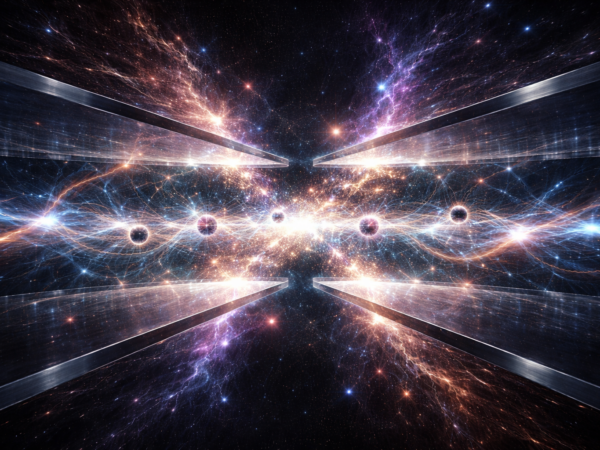
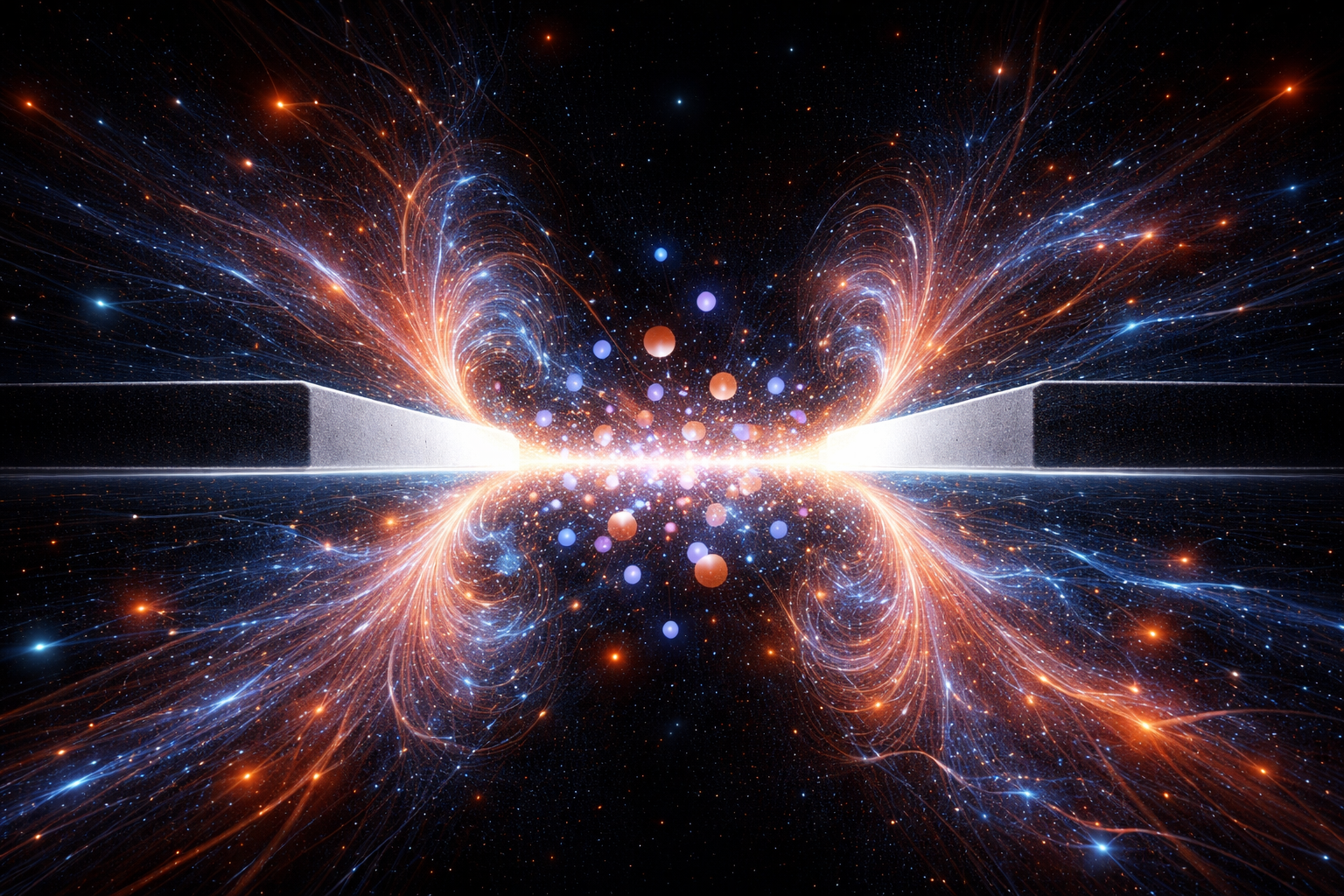
Two neutral metal plates in vacuum.
Distance: ~100 nm.
Classical prediction:
No force.
Quantum result:
Attraction.
Why?
| Region | Allowed wavelengths | Effect |
|---|---|---|
| Outside plates | All modes | Higher pressure |
| Between plates | Restricted modes | Lower pressure |
Result:
Vacuum pressure pushes plates together.
F/A = −π² ℏ c / (240 d⁴)
Precision:
- 1997: ±5%
- 1998: ±1%
- 2026: ~0.1%
This is the smoking gun.
Vacuum does physical work.
The Lamb Shift
Dirac theory predicted identical energy levels.
Experiment (1947):
They differ.
Shift ≈ 1057.8 MHz.
Cause:
Vacuum fluctuations perturb the electron.
E_shift ∝ α⁵ mc²
Modern experiments confirm this with extreme precision.
Even atoms interact with empty space.
Spontaneous Emission
Atoms emit light spontaneously.
Why?
The vacuum triggers it.
Emission rate:
Γ = (2π/ℏ) |⟨f|H_int|i⟩|² ρ(E)
Change the vacuum… change the emission.
Confirmed in:
- Cavity QED
- Superconducting qubits
- Quantum circuits
No vacuum → no light emission.
Modern Experiments
Casimir Engineering
- Nanometer precision measurements
- Superconductor transitions
- Temperature-dependent effects
Vacuum Control
RF cavities allow shaping vacuum fluctuations.
We are moving from observation…
to engineering.
Strong-Field QED
Ultra-power lasers probe vacuum nonlinearity.
Vacuum behaves like a medium.
Hawking Radiation
Vacuum near black holes produces particles.
T_H = ℏc³ / (8πGMk_B)
The vacuum depends on the observer.
The Vacuum Energy Problem
Quantum prediction:
ρ_vac ≈ 10²⁶⁷ GeV/cm³
Observed dark energy:
ρ_Λ ≈ 10⁻⁴⁷ GeV/cm³
Difference:
10¹²⁰×
The worst mismatch in physics.
Vacuum in Technology
| Technology | Vacuum role |
|---|---|
| Casimir devices | Nanoscale forces |
| Atomic clocks | Lamb shift corrections |
| Lasers | Spontaneous emission |
| Chemistry | van der Waals forces |
| Nuclear physics | Quantum tunneling |
No vacuum effects…
No modern civilization.
Cosmic Connection
Vacuum fluctuations seeded the universe.
- Inflation stretched quantum noise
- CMB preserves fluctuations
- Galaxies formed from them
The largest structures…
come from the smallest fluctuations.
The Final Realization
Space is not a container.
It is the foundation.
Particles are excitations of fields.
Vacuum is their ground state.
Nothingness has structure.
Emptiness has energy.
Void has dynamics.
We didn’t discover something inside space.
We discovered that space itself is something.
Reality does not emerge from stillness.
It emerges from fluctuation.
TL;DR
- Vacuum is not empty — it is fluctuating quantum fields.
- Casimir effect proves measurable forces from vacuum.
- Lamb shift shows vacuum alters atomic energy levels.
- Spontaneous emission depends on vacuum fluctuations.
- Vacuum underlies technology, atoms, and cosmology.
- Vacuum energy mismatch (10¹²⁰×) is a major unsolved problem.
References
- Casimir (1948). Conducting plate attraction.
- Lamoreaux (1997). Casimir experiment.
- Lamb & Retherford (1947). Hydrogen fine structure.
- Bethe (1947). QED correction.
- Hawking (1975). Black hole radiation.
- Milonni (1994). Quantum vacuum theory.
- Weisskopf & Wigner (1930). Emission theory.